
Blog
How Land Ownership Determines If Your Mobile Home Is Real or Personal Property
Whether a mobile home counts as real property or personal property comes down to three concrete facts: who owns the land, what kind of foundation the home sits on, and what the state title record says. This guide walks through the qualifying test our appraisers run before accepting an assignment, and explains when a file gets referred to a licensed real estate appraiser instead.
A mobile or manufactured home does not become real property just because it has stopped moving. Whether it counts as real property or personal property determines which kind of appraiser can even take the assignment, and getting that determination wrong can stall a sale, a refinance, or an estate filing before it starts. This guide walks through the three-part qualifying test our appraisers run before accepting a mobile home appraisal, and shows exactly where the line falls between personal property we appraise and real estate we refer out.
Why We Ask About the Land Before We Ask About the Home
The single biggest factor in classifying a mobile home is whether the homeowner owns the land underneath it or leases it. If the home sits on leased land, a rented pad in a community, or a lot borrowed from a family member without a recorded agreement, the home is treated as personal property in nearly every case, regardless of how nicely it is skirted or landscaped.
Fannie Mae's standard manufactured housing mortgage structure requires the borrower to hold fee-simple ownership of the land and requires a single lien covering both the land and the home before the pairing can qualify as real property collateral. HUD's own consumer guidance draws the same line: a home on land the owner directly holds is generally titled and taxed as real property and may qualify for conventional mortgage financing, while a home on paid leasehold land, or on family land with no written lease, is personal property in most cases, according to HUD's manufactured housing counseling materials.
Watch out: Owning the land is necessary but it is never sufficient on its own. A homeowner can own the lot outright and still have a personal property home if the foundation and title steps below have not happened.
Step Two: Is the Home Still on Wheels, or Set on a Permanent Foundation?
The second question is physical: does the home still have its axles, wheels, and hitch attached and remain transportable, or has it been set on a permanent foundation system? A home resting on piers, a temporary foundation, or its original running gear is still functionally a vehicle, and that transportability is one of the clearest signals that personal property treatment still applies.
Moving to a qualifying permanent foundation generally means installation in accordance with HUD's Model Manufactured Home Installation Standards (24 CFR Part 3285), which govern frost-line depth, anchoring, support spacing, and other structural requirements the home must meet before it can be treated as a permanent improvement to the land. That standard addresses how the home is physically secured. It does not, by itself, change what the title record says, which is the third and often overlooked piece of the test.
Step Three: What Does the State Title Record Say?
The final question is whether the home still carries an active vehicle-style title and registration, or whether that title has been surrendered or retired and an affidavit of affixation has been recorded with the county. An active title is strong evidence the home remains personal property no matter how permanent the foundation looks. A surrendered title paired with a recorded affidavit is the step that actually converts the asset in the eyes of the law.
Fannie Mae's underwriting materials note that in 43 states, a manufactured home remains personal property until the owner completes a statutory conversion procedure, which typically requires filing an affidavit of affixation, surrendering or cancelling the certificate of title, and recording the home as an improvement to the real estate. Our guide to mobile home title types walks through what an active title, a bonded title, and a retired title each look like in practice, and why the title record is the piece of paper that ultimately settles the question.
The Qualifying Test at a Glance
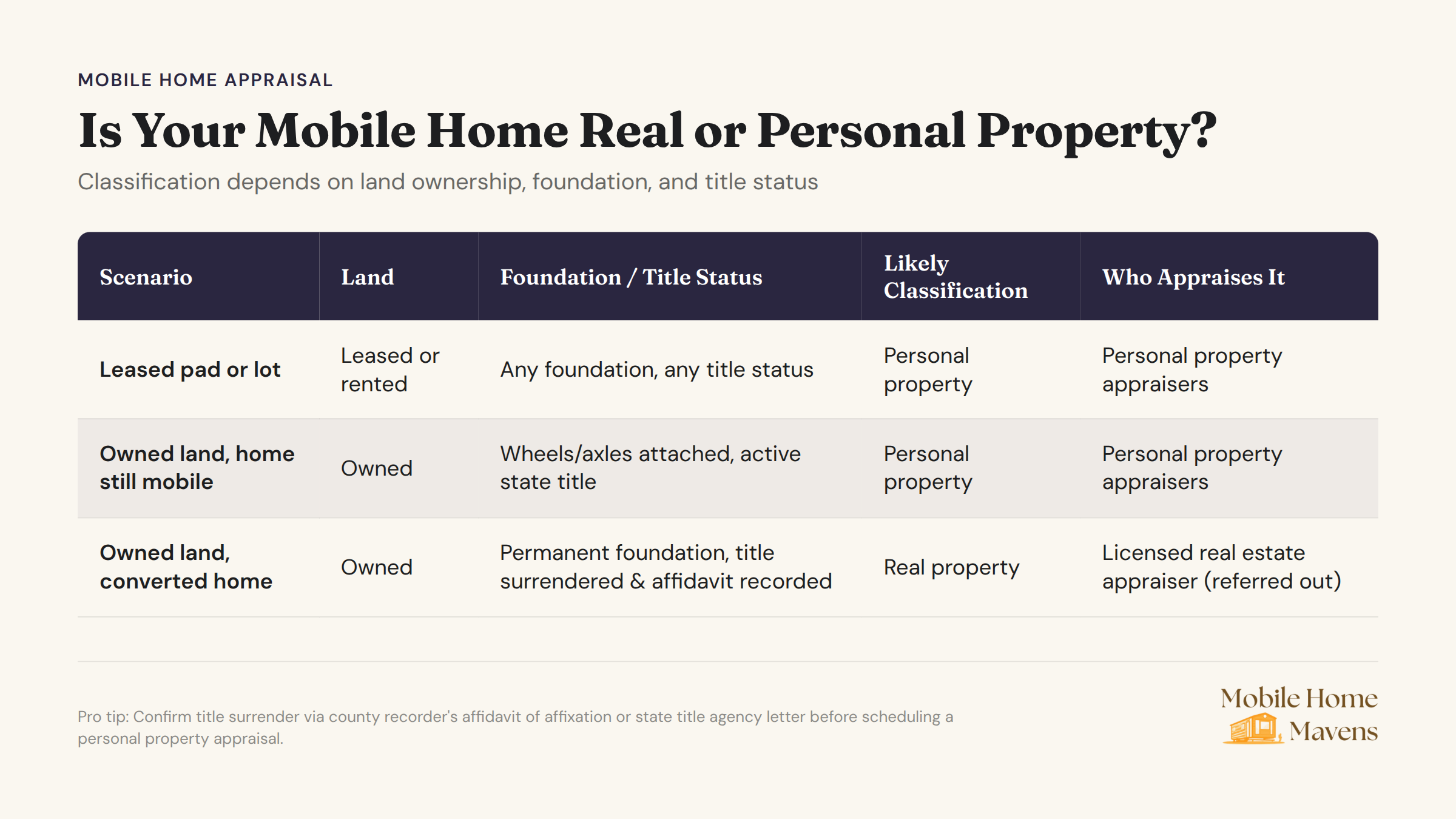
Putting the three questions together produces a short set of scenarios that cover most of the mobile and manufactured homes our appraisers encounter. The table below maps the common combinations to the likely classification and to who should handle the appraisal.
| Scenario | Land | Foundation / Title Status | Likely Classification | Who Appraises It |
|---|---|---|---|---|
| Leased pad or lot | Leased or rented | Any foundation, any title status | Personal property | Our personal property appraisers |
| Owned land, home still mobile | Owned | Wheels/axles attached, active state title | Personal property | Our personal property appraisers |
| Owned land, converted home | Owned | Permanent foundation, title surrendered and affidavit recorded | Real property | Licensed real estate appraiser (we refer out) |
Pro tip: If a homeowner owns the land, has a permanent-looking foundation, but is not sure whether the title was ever surrendered, that uncertainty is itself useful information. We ask to see the county recorder's affidavit of affixation or a letter from the state title agency before we schedule a personal property appraisal, because an unresolved title can mean the home is legally still chattel even though it looks settled in place.
Why HUD's Installation Standard Alone Doesn't Change the Classification
A home can meet every structural requirement of HUD's installation standard and still be personal property under state law. The installation standard answers an engineering question: is the home anchored and supported the way a permanent structure should be? It does not answer the legal question of whether the owner has taken the state-specific steps to convert the asset's title status.
That distinction matters because homeowners (and sometimes lenders) conflate "permanently installed" with "legally real property." They are related but separate facts. A contractor can set a home on a compliant permanent foundation in an afternoon. Converting the title and recording the affidavit of affixation is a separate administrative process, handled through the county recorder or the state's motor vehicle or housing finance agency, and it is the piece that actually changes the legal classification.
How State Law Controls the Recording Process
Every state has its own version of the conversion procedure, and the specific paperwork varies more than most homeowners expect. As one illustrative example of how a state structures this, Iowa law treats conversion as a two-part process: a mobile or manufactured home located outside a community or park must be placed on a permanent foundation and assessed for real estate taxes to convert under Iowa's statutory conversion framework, while a home that remains inside a manufactured-home community follows a separate surrender procedure in which the owner turns in the certificate of title to the county treasurer, who notifies the state transportation department and removes the title registration from county records.
That pattern, foundation plus a distinct title-surrender or recording act, repeats across most states even though the specific agency names, forms, and timing differ. Because the rules are set at the state level, the only reliable way to confirm a home's status is to check the title record and recorder's office in the county where the home sits, not to assume based on how the home looks or how long it has been in place.
When We Refer the File to a Licensed Real Estate Appraiser
Once a home sits on land the owner holds outright, has been set on a qualifying permanent foundation, and has had its certificate of title surrendered with an affidavit of affixation recorded, the asset has generally converted to real property. At that point the assignment falls outside the scope of a personal property appraisal and belongs with a licensed real estate appraiser working under real estate appraisal standards rather than personal property standards.
Our team holds credentials with organizations including the ISA, ASA, and AAA, and we prepare personal property reports in accordance with USPAP. When a mobile home clears all three parts of the qualifying test and has converted to real estate, we tell the client directly and point them toward a licensed real estate appraiser rather than taking on an assignment outside our scope. When the same home is still personal property, whether because the land is leased, the title is still active, or the conversion paperwork was never filed, it falls squarely within what our chattel appraisal guide describes, and it is exactly the kind of assignment our appraisers handle every week.
Confirm the Classification Before You Order an Appraisal
The fastest way to avoid a wasted appraisal fee is to answer the three qualifying questions before scheduling anything: who owns the land, what the foundation looks like, and what the title record actually says. Most homes on leased land or with an active title are personal property and are ready for our appraisers to begin right away. Homes on owned land with a permanent foundation and a surrendered title usually need a real estate appraiser instead, and we would rather tell a client that up front than deliver a report that does not match the asset's actual legal status.
This article is provided for general informational purposes only and does not constitute legal, tax, or financial advice. Readers should consult a qualified attorney or title professional regarding the classification of a specific property.