
Blog
Mobile Home Title Types Explained: Clean, Bonded, and Lost Title Compared
Mobile home title types fall into three categories: clean, bonded, and lost. This guide explains what each one means, how owners resolve it, and when a mobile home appraisal can proceed even before the title is fully cleared.
A mobile home's title status and its appraised value are two separate questions, but owners frequently confuse them. Whether your home carries a clean title, a bonded title, or a lost title that needs a duplicate filed, the distinction affects what you can do with the home next, not necessarily whether an appraiser can put a defensible number on it today. This guide walks through the three title statuses owners actually encounter and explains when title resolution has to happen before an appraisal, and when the two processes can run in parallel.
Why Title Status Matters Before You Order a Mobile Home Appraisal
A mobile home appraisal values the home. It does not resolve who legally owns it. Those are two different functions, handled by two different parties: an appraiser determines fair market value using the sales comparison approach, while the DMV, housing agency, or county tax office determines who holds legal title.
Our mobile home appraisal service treats manufactured and mobile homes as personal property (chattel) in most jurisdictions, valued against comparable sales of similar make, model, age, and condition rather than land-based real estate comparables. That valuation work can often begin regardless of where the title stands, but the title status determines what the finished report can actually be used for. A lender closing a purchase loan needs clean title at closing. An estate attorney documenting value for probate usually doesn't.
What Is a Clean Title on a Mobile Home?
A clean title, sometimes called a regular or marketable title, is a valid certificate of title issued in the current owner's name with no unresolved liens and no unresolved ownership disputes. It is the standard, uncomplicated status most mobile homes carry.
Florida's motor vehicle and mobile home title statute illustrates the general principle followed by most states: a buyer does not acquire marketable title to a mobile home until a certificate of title has been issued in that buyer's name, regardless of who sold it or whether the seller was a licensed dealer. Possession, a bill of sale, or a verbal agreement is not the same thing as marketable title.
A clean title means:
- The certificate names the current owner with no gaps in the chain of ownership.
- Any liens that once existed have been formally released and recorded as such.
- The titling agency (DMV, MVD, or housing department, depending on the state) will accept it for transfer without additional documentation.
This is the status lenders, title companies, and buyers expect at a sale or refinance closing.
What Is a Bonded Title, and How Long Does It Last?
A bonded title is issued when an owner cannot produce standard proof of ownership, so the titling agency requires a surety bond instead. The bond financially protects any prior owner, lienholder, or future purchaser who might later have a legitimate claim against the property, while still allowing the current possessor to obtain a usable title.
States set their own bond amounts, and they vary. Michigan's mobile home title statute requires a bond equal to twice the value of the mobile home as determined by the department when ownership documentation is insufficient. Nevada's manufactured home statute sets its bond at one and one-half times the most recent assessed value from the county assessor. Other states use their own multiples and procedures, so the specific bond amount always depends on the state and, often, the county's assessed value of the home.
As general examples of how the process plays out on the ground: California's Department of Housing and Community Development handles bonded titling for manufactured homes through its own registration and titling process, while Georgia routes manufactured home title work through the county tax commissioner's office using state-specific forms. These are illustrations of how titling agencies differ by state (some use a DMV-style motor vehicle model, others use a housing or tax agency), not a universal procedure every owner will follow.
Once issued, a bonded title typically functions like a normal title for most day-to-day purposes such as insuring the home or applying for financing. Many states impose a statutory waiting period, often around three years, after which the bond expires and the title converts to unencumbered, clean status if no claim was filed against it.
Our bonded title mobile home appraisal page covers the bonding process itself in more depth if you're actively working through it.
Watch out: A bonded title is not a lesser or temporary form of ownership. It's a fully valid title from the day it's issued; the bond simply sits behind it as insurance until the statutory window closes.
What Is a Lost Title, and How Is It Different From a Bonded Title?
A lost title situation is different from a bonded title, even though owners frequently mix the two up. With a lost title, the owner is already the confirmed, record owner in the titling agency's files. The physical certificate (or the prior electronic record) is simply missing, stolen, mutilated, or was never received.
California's regulations for manufactured homes and mobilehomes spell this out directly: when a title "is lost, stolen, mutilated, illegible, or was not received," the legal or registered owner applies for a duplicate certificate of title rather than a bond. Because ownership is already established in the agency's records, no surety bond is required; the agency simply re-issues the paperwork.
The distinction only breaks down when the missing title also comes with a broken chain of ownership, meaning the agency can't confirm who the rightful owner actually is. Nebraska's DMV, for example, directs owners who cannot produce standard proof of ownership toward a bonded certificate of title process rather than a simple duplicate, precisely because a duplicate title assumes ownership isn't in dispute.
Pro tip: If you know you're the rightful owner and the agency's own records agree, ask specifically for a duplicate or replacement title application. Only ask about bonded title procedures if the agency tells you your ownership documentation is incomplete.
Clean vs Bonded vs Lost Title: Side-by-Side Comparison
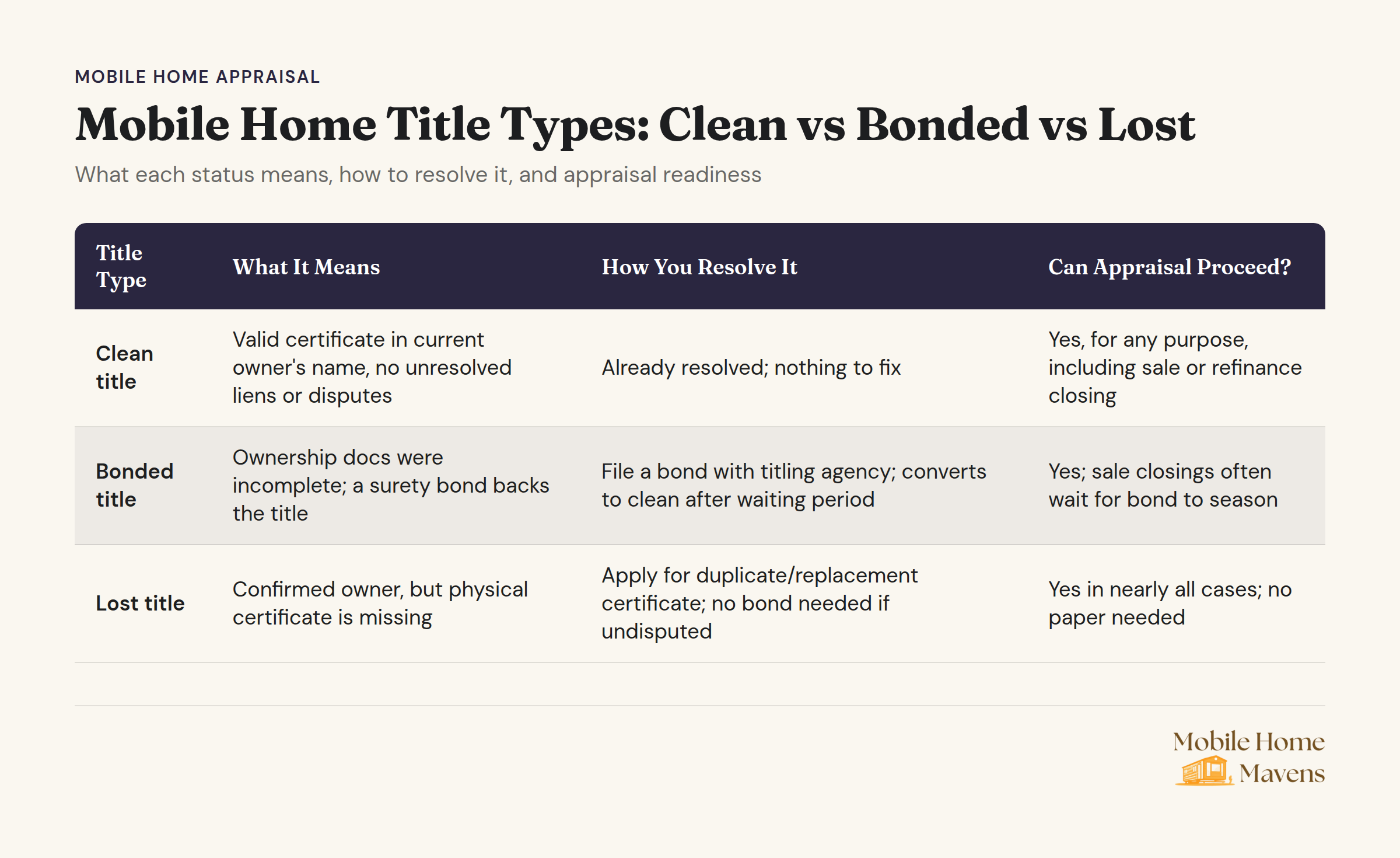
The table below summarizes what each status means, how an owner typically resolves it, and whether a mobile home appraisal can move forward while that resolution is in progress.
| Title Type | What It Means | How You Resolve It | Can an Appraisal Proceed? |
|---|---|---|---|
| Clean title | Valid certificate in current owner's name, no unresolved liens or disputes | Already resolved; nothing to fix | Yes, for any purpose including sale or refinance closing |
| Bonded title | Ownership documentation was incomplete, so a surety bond stands behind the title | File a bond with the titling agency; converts to clean title after a statutory waiting period | Yes, for financing, estate, or insurance purposes; sale closings often wait for the bond to season |
| Lost title | Owner is the confirmed record owner, but the physical certificate is missing | Apply for a duplicate or replacement certificate; no bond needed if ownership isn't in dispute | Yes, in nearly all cases; the appraisal doesn't depend on having the paper in hand |
Can a Mobile Home Appraisal Proceed Without a Clean Title?
In most cases, yes. An appraisal values the home; it doesn't adjudicate ownership, so a bonded or in-process title rarely stops the appraisal itself. What it can affect is what the finished report gets used for.
Mobile home appraisals ordered for financing, estate settlement, insurance coverage, or gift and tax purposes generally don't require a clean title on the day of inspection, because the party relying on the report (a lender's underwriting file, a probate court, an insurer) is asking what the home is worth, not who currently holds title. Our mobile home appraisal for loan collateral service, for instance, is routinely ordered while a bonded title is still within its statutory waiting period, since the lender's underwriting simply needs a defensible value on file.
A mobile home appraisal through our team is quoted as a fixed fee of $595, delivered online through photos and documentation the owner provides, using the sales comparison approach against similar homes. That fee is set before work begins and doesn't change based on the title's status; it's driven by the scope of the assignment (the home's size, age, and complexity), not by whether the title is clean, bonded, or in the middle of a duplicate application.
Key takeaway: Order the appraisal for what you need it for. If you're settling an estate, insuring the home, or working with a lender, a bonded or lost title in progress usually won't hold up the valuation.
When Should You Resolve Title Before Ordering an Appraisal?
Sale and refinance closings are the clear exception. A title company or closing attorney handling a purchase transaction will typically require a clean, marketable title in the seller's name before funds change hands, since the buyer is taking on the risk of any unresolved claim. If you're mid-sale and discover your title is bonded or lost, resolving that with the titling agency usually needs to happen before, or in tandem with, the closing timeline, not after.
For everything else, financing applications, estate inventories, insurance claims, gift tax filings, or divorce property division, the appraisal and the title cleanup can typically run on separate tracks. Order the valuation when you need the number; keep working the title with the DMV, MVD, or housing agency in parallel.
Mobile home titling agencies vary by state (some run through a motor vehicle division, others through a housing department or the county tax office), so always confirm the specific process with your state's agency before assuming a timeline. Our FAQ page covers several related ownership and documentation questions if you're trying to sort out where your home stands before you order an appraisal.
This article is provided for general informational purposes only and does not constitute legal, tax, or financial advice. Readers should consult a qualified attorney or their state's titling agency regarding their specific circumstances.