
Blog
Chattel Appraisal for Mobile Homes: What It Is and When You Need One
A chattel appraisal values a mobile or manufactured home as personal property rather than real estate, and it's often required for chattel loans, refinancing, and estate matters. This guide explains when you need one, how the value is determined, and what a USPAP-compliant report must include.
What Is a Chattel Appraisal?
A chattel appraisal is a valuation of a mobile or manufactured home as personal property, separate from any land it sits on. It's used when the home is titled on its own, most often because it sits on leased land or hasn't been permanently affixed to a foundation, and it's the valuation lenders, courts, and estates rely on when the home itself, not the ground beneath it, is the asset being financed or divided.
The term "chattel" simply means movable personal property, as distinct from real property that's permanently attached to land. A chattel mortgage is a loan secured by that movable property, and a chattel appraisal is the report that establishes what the collateral is actually worth. For manufactured and mobile homeowners, that distinction matters more than almost anything else in the transaction, because it determines which set of rules, which loan product, and which valuation method applies.
At Mobile Home Mavens, we prepare chattel appraisals for owners, lenders, and attorneys who need a defensible, USPAP-compliant value on a mobile or manufactured home classified as personal property. If you're not sure whether your home qualifies as chattel in the first place, that question is covered in detail below.
When You Need a Chattel Appraisal
You'll typically need a chattel appraisal any time a mobile or manufactured home is financed, refinanced, or transferred as personal property rather than real estate. The most common triggers fall into two buckets: financing situations and personal or legal matters.
Chattel Loans and Refinancing
A chattel loan is the standard financing tool for homes titled separately from the land, and it's regulated differently than a traditional mortgage. Under the Truth in Lending Act's high-cost mortgage (HPML) rules, lenders generally cannot close certain manufactured home chattel loans without obtaining a written valuation of the home, performed by a certified or licensed appraiser who conducts a physical interior inspection, unless the loan amount falls at or below a specified exemption threshold (Fannie Mae's legal analysis of manufactured home chattel loans).
For newer manufactured homes, some lenders may accept a manufacturer's invoice or a qualified valuation in place of a full appraisal, but the requirements vary by loan program and lender (Fannie Mae's legal analysis of manufactured home chattel loans). Because chattel loans are underwritten more like vehicle or equipment financing than a home mortgage, with shorter terms and different consumer protections, lenders lean heavily on the appraisal to confirm the collateral supports the loan amount (Realtor.com on manufactured home loans).
Owners refinancing an existing chattel loan usually need an updated appraisal too, since the lender is re-underwriting the same personal property collateral under current market conditions.
Estate, Probate, Divorce, and Tax Matters
When a mobile or manufactured home is titled as personal property, it's treated like a vehicle or piece of equipment in probate and estate proceedings, not like a house. That means:
- Probate and estate settlement: An executor needs a documented value of the chattel home to divide assets or file estate paperwork accurately.
- Divorce and equitable distribution: Courts need an independent value for the home when it's part of the marital estate, separate from any land dispute.
- Bankruptcy filings: Trustees and courts require a current, defensible value of chattel assets, including manufactured homes, to determine exemptions and distributions.
- Tax and accounting purposes: Owners may need a chattel value for gift tax, casualty loss, or basis calculations tied to the home alone.
In every one of these scenarios, the appraiser is valuing the home as movable personal property, using personal property valuation standards rather than real estate methodology.
Pro tip: Before you order any appraisal, confirm how your home is actually titled. Many owners assume their home is real estate simply because it hasn't moved in years, when the title office still classifies it as personal property. Getting this wrong can delay a loan closing or an estate filing by weeks.
Chattel Appraisal vs. Real Estate Appraisal
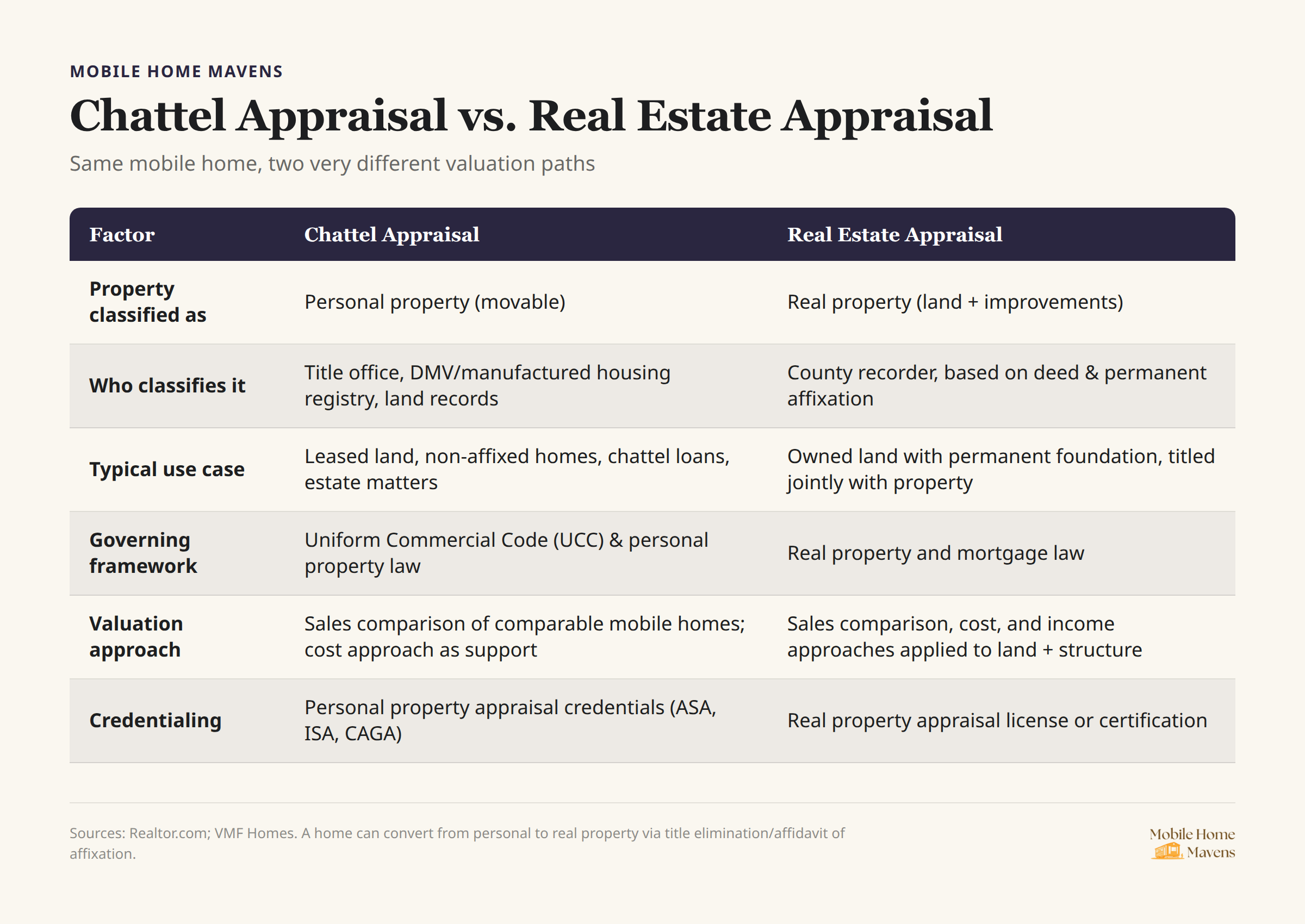
The biggest difference between a chattel appraisal and a real estate appraisal is what's being valued: a chattel appraisal values the home alone as movable property, while a real estate appraisal values land and improvements together as a single real property interest. That distinction changes the loan type, the appraiser's approach, and even the underlying law that governs the transaction.
| Factor | Chattel Appraisal | Real Estate Appraisal |
|---|---|---|
| Property classified as | Personal property (movable) | Real property (land plus improvements) |
| Who classifies it | Title office, state DMV/manufactured housing registry, or land ownership records | County recorder, based on deed and permanent affixation |
| Typical use case | Homes on leased land, homes not permanently affixed, chattel loans, estate/personal property matters | Homes on owned land with a permanent foundation, titled jointly with the property |
| Governing framework | Uniform Commercial Code (UCC) and personal property law (Realtor.com) | Real property and mortgage law |
| Valuation approach | Sales comparison of comparable mobile/manufactured homes, cost approach as secondary support | Sales comparison, cost approach, and income approach applied to land and structure together |
| Credentialing | Personal property appraisal credentials (ASA, ISA, CAGA) | Real property appraisal license or certification |
A home can move between these two categories. VMF Homes notes that a mobile home is generally treated as personal property unless it's been permanently affixed to land and titled together with it, at which point it can be converted to real property under state procedures (VMF Homes). That conversion process, sometimes called a title elimination or affidavit of affixture, is exactly why the classification question has to be answered before anyone orders the wrong type of appraisal.
If you're trying to determine which category your home falls into before ordering anything, our guide on mobile homes as personal property versus real property walks through the classification test in more depth.
How Is a Mobile Home's Chattel Value Determined?
Chattel value for a mobile or manufactured home is primarily determined through the sales comparison approach: analyzing recent sales of similar homes (matched by age, size, configuration, and condition) and adjusting for differences. A cost-based approach, using depreciated replacement cost or manufacturer data, serves as secondary support rather than the primary method.
Sales Comparison Approach (Primary)
The appraiser identifies comparable mobile or manufactured homes that have sold recently, ideally in similar communities or markets, and adjusts for differences in:
- Age and HUD Code compliance: Homes built after June 15, 1976, fall under the federal HUD Code for manufactured housing, and age materially affects both marketability and depreciation.
- Size and configuration: Single-section versus multi-section homes, square footage, and layout all move the comparable set.
- Condition: Interior and exterior condition, updates, and any deferred maintenance identified during inspection.
- Location factors: For homes on leased land, the desirability of the community, lot rent levels, and local demand influence resale value even though the land itself isn't part of the appraisal (MHVillage's mobile home value guide).
MHVillage, one of the larger marketplaces for manufactured housing, specifically recommends a market-based appraisal from a specialist for homes in land-lease communities, since general real estate valuation tools don't capture the nuances of chattel sales data (MHVillage).
Cost Approach and Reference Data (Secondary)
For newer homes, or when comparable sales are thin, appraisers may weigh replacement cost data and manufacturer information more heavily. Industry-standard reference guides, including manufactured housing valuation guides used across the appraisal profession, provide baseline cost and depreciation data that appraisers cross-check against local market evidence rather than rely on in isolation.
Every chattel appraisal we prepare is developed in accordance with USPAP, the Uniform Standards of Professional Appraisal Practice published by The Appraisal Foundation. That standard governs how the appraiser gathers data, applies methodology, and documents conclusions, regardless of whether the assignment is for a lender, a court, or an estate.
Personal Property vs. Real Property: How Classification Is Decided
Whether a mobile or manufactured home is legally personal property or real property comes down to three questions: how it's titled, how it's attached to the land, and who owns the land underneath it. This classification decision happens before any appraisal is ordered, because it determines which type of report, and which lender rules, apply.
The questions an appraiser or title examiner typically works through include:
- Foundation type: Is the home set on a permanent, poured foundation, or does it still rest on a chassis with axles and wheels, even if they're no longer functional?
- Land ownership: Does the homeowner own the land underneath the home, or is the home sited on leased land in a community?
- Titling status: Is the home titled through the state DMV or manufactured housing registry as a vehicle-style title, or has that title been retired and the home combined with the land deed?
- Intent at installation: Was the home installed with the clear intent to remain permanently, or was it set up in a way that allows relocation?
Homes on leased land are almost always chattel, since the owner can't combine title with land they don't own (Realtor.com; VMF Homes). Homes on owned land with a permanent foundation and a retired chassis title are more likely to qualify as real property, assuming the state's affixation and titling procedures were followed correctly.
Watch out: Don't assume a home is real property just because it looks permanent. If the state title was never formally retired, or the home sits on leased land, it may still be legally chattel regardless of how it's built or how long it's been in place. Ordering a real estate appraisal on a chattel home (or vice versa) wastes time and money, and can delay a closing.
If you want a deeper walkthrough of this test, our related guide on chattel appraisals for mobile and manufactured home owners covers additional scenarios, including homes on leased land specifically discussed in our leased land appraisal guide.
What's Included in a Chattel Appraisal Report
A compliant chattel appraisal report documents the subject home, the methodology applied, the supporting data, and the appraiser's final opinion of value, all prepared in accordance with USPAP so the report meets typical lender, court, or estate documentation requirements. At minimum, the report should include:
- Subject property description: Manufacturer, model, year, serial/VIN and HUD label numbers, dimensions, and configuration (single or multi-section).
- Statement of purpose and intended use: Why the appraisal was ordered (loan, estate, tax, litigation) and who the intended user is.
- Inspection details: Confirmation of an interior and exterior physical inspection, including date and scope.
- Valuation approaches applied: The sales comparison analysis, with adjusted comparables, and any supporting cost approach data.
- Comparable sales data: A summary of recent, similar mobile or manufactured home sales used to support the value conclusion.
- Photographs: Interior and exterior images documenting condition at the time of inspection.
- Certification and signature: The appraiser's signed certification of independence, competency, and compliance with USPAP.
This structure is what allows a lender's underwriting team, a probate court, or a divorce attorney to rely on the report as an independent, standards-based opinion of value rather than an informal estimate.
Get a Chattel Appraisal from Mobile Home Mavens
Mobile Home Mavens prepares USPAP-compliant chattel appraisals for mobile and manufactured homeowners nationwide, whether you need one for a chattel loan, a refinance, an estate matter, or a divorce settlement. Our fixed-fee online appraisal service is $595, with reports built to meet typical lender and legal documentation requirements without the wait or expense of an in-person visit for most standard assignments.
If you're ready to move forward, you can request a mobile home appraisal directly through our site, or start with our overview of the mobile home appraisal process to see how the full engagement works from order to report delivery.
Frequently Asked Questions
Q: Does a chattel appraisal require an on-site visit? Most chattel appraisals do require a physical inspection of the home, including the interior, particularly when the report supports a high-cost mortgage loan under federal rules (Fannie Mae's legal analysis of manufactured home chattel loans). Some lenders accept alternative valuations for new homes, such as a manufacturer's invoice, but a standard chattel appraisal typically involves an appraiser physically reviewing the home's condition.
Q: Can a chattel appraisal be used for both a loan and an estate matter? A single report is typically prepared for one specific intended use and intended user, since the purpose shapes the scope of work. If you need the value for both a refinance and an estate filing, it's best to confirm with each party (the lender and the estate's attorney or accountant) whether a single report satisfies both, or whether two separate assignments are needed.
Q: What if I'm not sure whether my home is chattel or real property? Start by checking your title documents and confirming with your state's DMV or manufactured housing registry whether a vehicle-style title is still active. If you're still unsure, an appraiser can often help identify the correct classification before the assignment begins, which avoids ordering the wrong type of report.
Sources and Further Reading
- Definition of a chattel mortgage and how it differs from a traditional mortgage: Bankrate
- HPML appraisal requirements, interior inspection rules, and alternative valuation options for manufactured home chattel loans: Fannie Mae legal analysis
- Real property versus personal property classification and UCC treatment of chattel loans: Realtor.com
- Market-based appraisal recommendations for mobile homes in land-lease communities: MHVillage mobile home value guide
- Conditions under which a mobile home can convert from personal property to real property: VMF Homes
This article is provided for general informational purposes only and does not constitute legal, tax, or financial advice. Readers should consult a qualified attorney or CPA regarding their specific circumstances.