
Blog
How Mobile Home Depreciation Works and Why It Differs From Site-Built Homes
Mobile home depreciation follows a different curve than site-built home appreciation, and the biggest driver is whether the home sits on leased or owned land. This guide explains why manufactured homes lose value early and how appraisers calculate that decline using the cost approach.
If you've watched your manufactured home's estimated value tick downward year after year while your neighbor's site-built house keeps climbing, you're not imagining it. Mobile home depreciation follows a fundamentally different curve than the appreciation pattern most homeowners expect from residential real estate, and the reason has less to do with the home itself than with a piece of paper: the title. Our mobile home appraisal team asks about land status, construction quality, and market conditions on every engagement, because that combination determines whether a home is even eligible to appreciate at all.
Land Ownership Is the Single Biggest Factor in Mobile Home Depreciation
The direct answer: a manufactured home titled as personal property on leased land depreciates the way a vehicle does, while a home permanently affixed to land the owner holds title to can appreciate at rates closer to a site-built house in the same market.
Analysis by the Urban Institute found that manufactured homes, as a class, appreciate more slowly than site-built homes, and pointed to a key reason: much of a site-built home's appreciation comes from the value of the land beneath it, not the structure itself. That distinction cuts the other way when land is part of the deal. A home sold and financed together with the land the owner holds title to starts behaving like real estate rather than a depreciating chattel, and tends to track the broader housing market far more closely.
We cover the legal mechanics of that classification in more depth in our guide on whether a mobile home counts as personal property or real estate, but the short version matters here: a home on a rented lot in a manufactured home community is almost always titled as personal property. A home on land the owner holds title to, with the title retired and the home permanently affixed, is far more likely to be treated as real property.
That classification cascades into financing, and financing shapes demand. Homes titled as personal property are typically financed with chattel loans rather than traditional mortgages, and chattel loans carry higher interest rates and shorter terms. We break down how that financing distinction affects value in our explainer on chattel appraisals for mobile and manufactured homes. Fewer buyers qualify for or want that financing, which thins the pool of demand and puts downward pressure on resale value, independent of the home's physical condition.
The Shape of the Depreciation Curve for Manufactured Homes
For personal-property-classified homes, depreciation tends to be steepest in the first several years of ownership and then slows as the home ages further. Three forces drive that curve.
Physical deterioration hits hardest early. Roofing, siding, plumbing fixtures, and interior finishes on a manufactured home wear at a predictable pace, and the first owner absorbs most of that decline before the curve flattens.
Functional obsolescence compounds the problem as newer HUD-code units come to market with better insulation, modern layouts, and more efficient systems. A 15-year-old floor plan competes against homes built to current standards, and buyers notice the gap in energy costs and livability even when the older home is well maintained.
Economic obsolescence shows up through financing and location. A home in a park with rising lot rents, declining occupancy, or an uncertain lease renewal carries risk that a buyer's lender will price in, which is a form of value loss that has nothing to do with the home's roof or plumbing.
Example: Two identical single-section homes are built the same year. One sits on a rented lot in a park with month-to-month leases and rising fees. The other sits on land the owner purchased and holds free and clear. Ten years later, the leased-lot home has likely lost a meaningful share of its original value, while the owned-land home may be worth close to, or more than, its original price, simply because it competes in the broader real estate market instead of the personal-property market.
Watch out: Don't assume every mobile home loses value at the same pace. A well-maintained, upgraded home on owned land can hold value far better than a neglected home twice its age on leased land, because land status and upkeep matter more than the calendar.
How Appraisers Calculate Mobile Home Depreciation: The Cost Approach
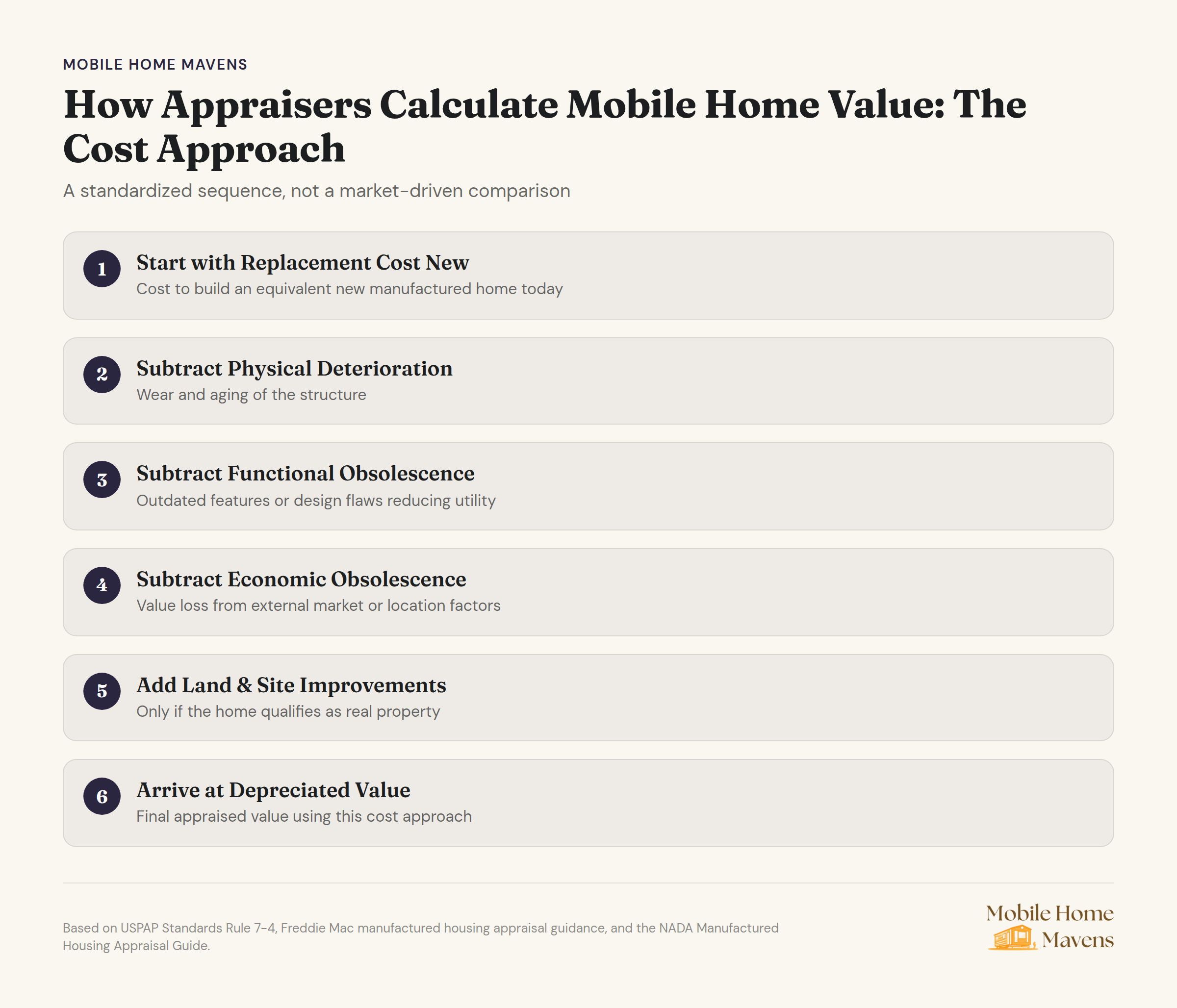
Appraisers typically develop mobile home value through the cost approach: replacement cost new, less physical deterioration, less functional obsolescence, less economic obsolescence, plus the value of the land and site improvements if the home qualifies as real property. This mirrors USPAP Standards Rule 7-4, which requires an appraiser to consider all recognized approaches to value and select the ones applicable to the assignment.
For mortgage-related appraisals, industry guidance summarizing Freddie Mac's manufactured housing requirements notes that the cost approach using published cost services is mandatory and cannot be modified by an appraiser's subjective adjustments. That means the depreciation factors applied to a manufactured home in a lending context come from a standardized, published schedule rather than an appraiser's individual judgment call, which is a meaningful difference from how a site-built home is typically appraised.
The NADA Manufactured Housing Appraisal Guide works on a similar principle: current replacement cost, minus depreciation tied to the home's age and condition, with the depreciation schedule doing most of the analytical work rather than a purely market-driven sales comparison.
Pro tip: If you're trying to understand why an appraised value came back lower than a private sale listing you saw for a similar home, ask whether that comparable was titled the same way (personal property versus real property) and financed the same way. Comparing across classifications is one of the most common sources of confusion for homeowners.
Leased Land vs. Owned Land: Two Different Depreciation Paths
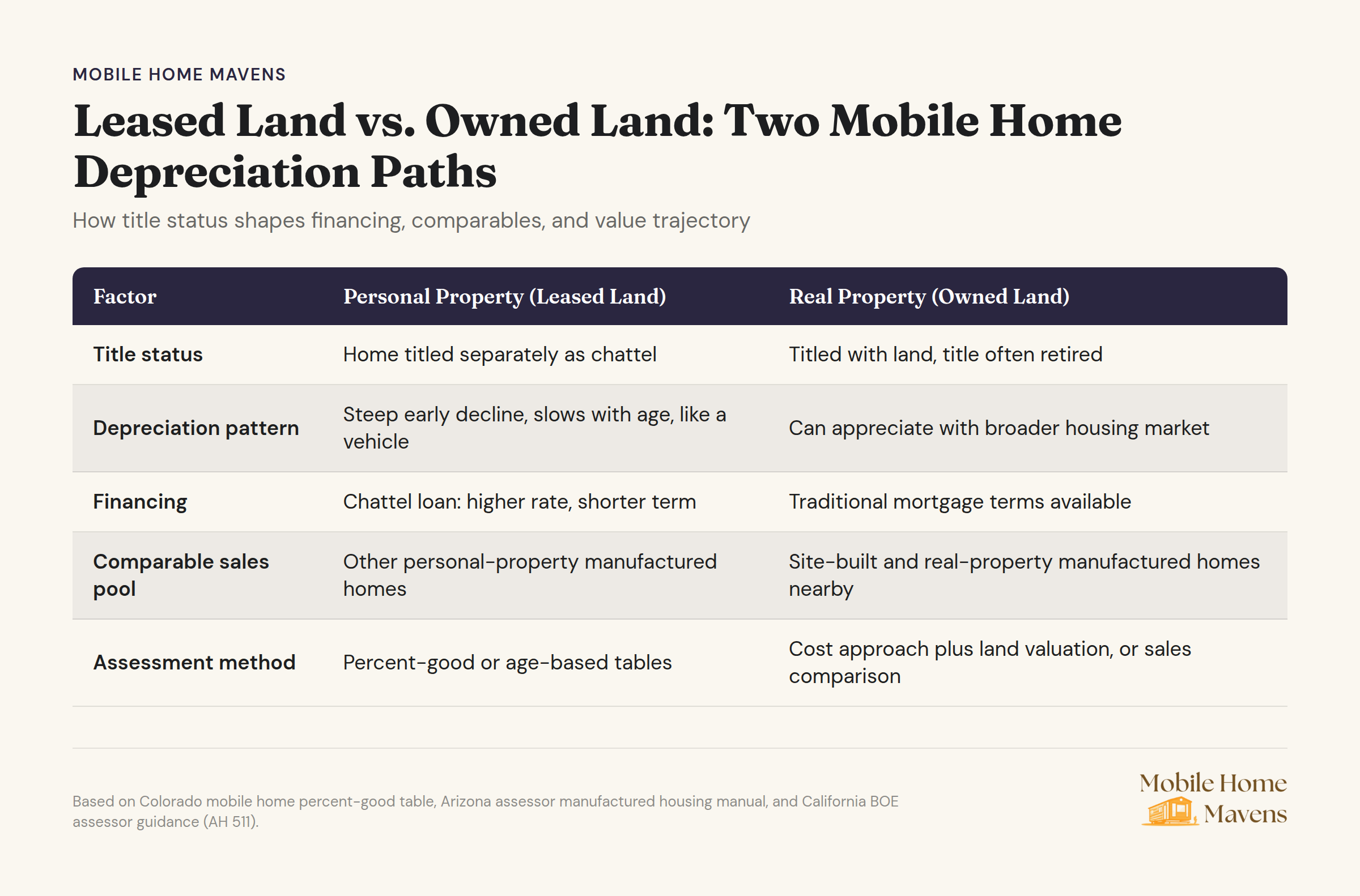
The table below contrasts the two dynamics side by side. The differences start with the title and ripple through financing, comparables, and the long-term value trajectory.
| Factor | Personal Property (Leased Land) | Real Property (Owned Land) |
|---|---|---|
| Title status | Home titled separately as chattel | Home titled with land, title often retired |
| Depreciation pattern | Steep decline early, slows with age, similar to a vehicle | Can appreciate with the broader housing market |
| Financing | Chattel loan: higher rate, shorter term | Traditional mortgage terms available |
| Comparable sales pool | Other personal-property manufactured homes | Site-built and real-property manufactured homes in the area |
| Assessment method | Standardized percent-good or age-based tables | Cost approach plus separate land valuation, or sales comparison |
State property tax authorities illustrate the personal-property side of this table directly. Colorado's assessment rules include a mobile home percent-good table that depreciates a home's assessed value each year based on age, capped at a fraction of its original retail price. Arizona's assessor manual uses separate depreciation schedules for single-section and multi-section units, pulling directly from the title record rather than a subjective quality grade.
On the real-property side, California's assessor guidance describes extracting site value from sales prices before using them as comparables, then depreciating the home's cost separately from the land. That two-part analysis, land plus depreciated improvement, is much closer to how a site-built home gets appraised than to how a leased-lot mobile home gets assessed.
Age Isn't the Whole Story
Age drives a meaningful share of a manufactured home's depreciation, but it isn't the whole story. Two homes built in the same year can land on very different value trajectories depending on maintenance, upgrades, and, again, land status.
A home with a replaced roof, updated kitchen, and new HVAC system will show less physical deterioration than an identical model that has had no capital improvements, even at the same age. A home that was moved from leased land onto an owned lot and permanently affixed can shift its trajectory from a depreciating curve to something closer to appreciation, because the classification itself changed.
Key takeaway: Age sets the starting point for a depreciation estimate, but condition, upgrades, and land status determine where the home actually lands on that curve. An appraisal that only looks at the year of manufacture is missing most of the analysis.
Why We Confirm Land Status Before We Quote Your Mobile Home Appraisal
Based on our experience at Mobile Home Mavens, the first question we ask on nearly every appraisal request is whether the home sits on leased land or land the owner holds title to. That answer determines the classification, the applicable approach to value, and in some cases whether the home even qualifies as real property for the appraisal's intended use.
For mobile homes on leased land, which are appraised as personal property, we quote a fixed fee of $595 for an online appraisal, confirmed after we verify the land status and scope the assignment. Engagements are always quoted as a fixed fee before work begins, never billed by the hour, and the fee reflects the scope of the assignment rather than the home's condition or market value.
Understanding Your Home's Real Trajectory
Mobile home depreciation isn't a mystery once you separate the two variables that actually drive it: land classification and physical condition. A home on leased land will generally follow a curve that looks like a vehicle's, steep early and flatter later, shaped by wear, outdated features, and financing limits. A home permanently affixed to owned land has a real shot at behaving like the rest of the housing market around it.
If you need a defensible, USPAP-compliant opinion of your home's current value, whether for a loan, an estate matter, or a sale, our mobile home appraisal team can walk you through which category your home falls into and what that means for its value.
This article is provided for general informational purposes only and does not constitute legal, tax, or financial advice. Readers should consult a qualified attorney or CPA regarding their specific circumstances.