
Blog
Why Do Two Mobile Home Appraisals Come Back with Different Values?
Two independent mobile home appraisals rarely land on the exact same number, and that's not a red flag by itself. This guide explains the real drivers behind the gap, from land classification to comp selection, and what to do when the difference is too large to ignore.
A homeowner orders one appraisal for a refinance and a family orders a second for an estate, and the two reports come back $8,000 apart on the same manufactured home. The instinct is to assume someone made a mistake. Usually, nobody did.
A Range Is Normal, Not a Red Flag
Two qualified appraisers can look at the same manufactured home and reach different, equally defensible conclusions of value. Appraisal practice is not a single formula that spits out one right answer; it's a professional opinion built from judgment, reconciliation, and the specific facts available to that appraiser on that day.
Standards published by The Appraisal Foundation give appraisers latitude to select and weigh approaches to value, and to reconcile multiple indications into a final opinion using professional judgment rather than a fixed rule. That's why our mobile home appraisal team expects some variance between reports, even competent ones. The question isn't whether two numbers match exactly; it's whether each number is supported by the data and reasoning behind it.
Where the gap becomes a problem is when it's large, say more than 10% to 15% apart, or when the two reports were prepared for different purposes without anyone noticing. The sections below walk through the most common, legitimate reasons values diverge, and what's worth double-checking when they diverge too much.
Real Property vs Personal Property Classification Drives the Biggest Gaps
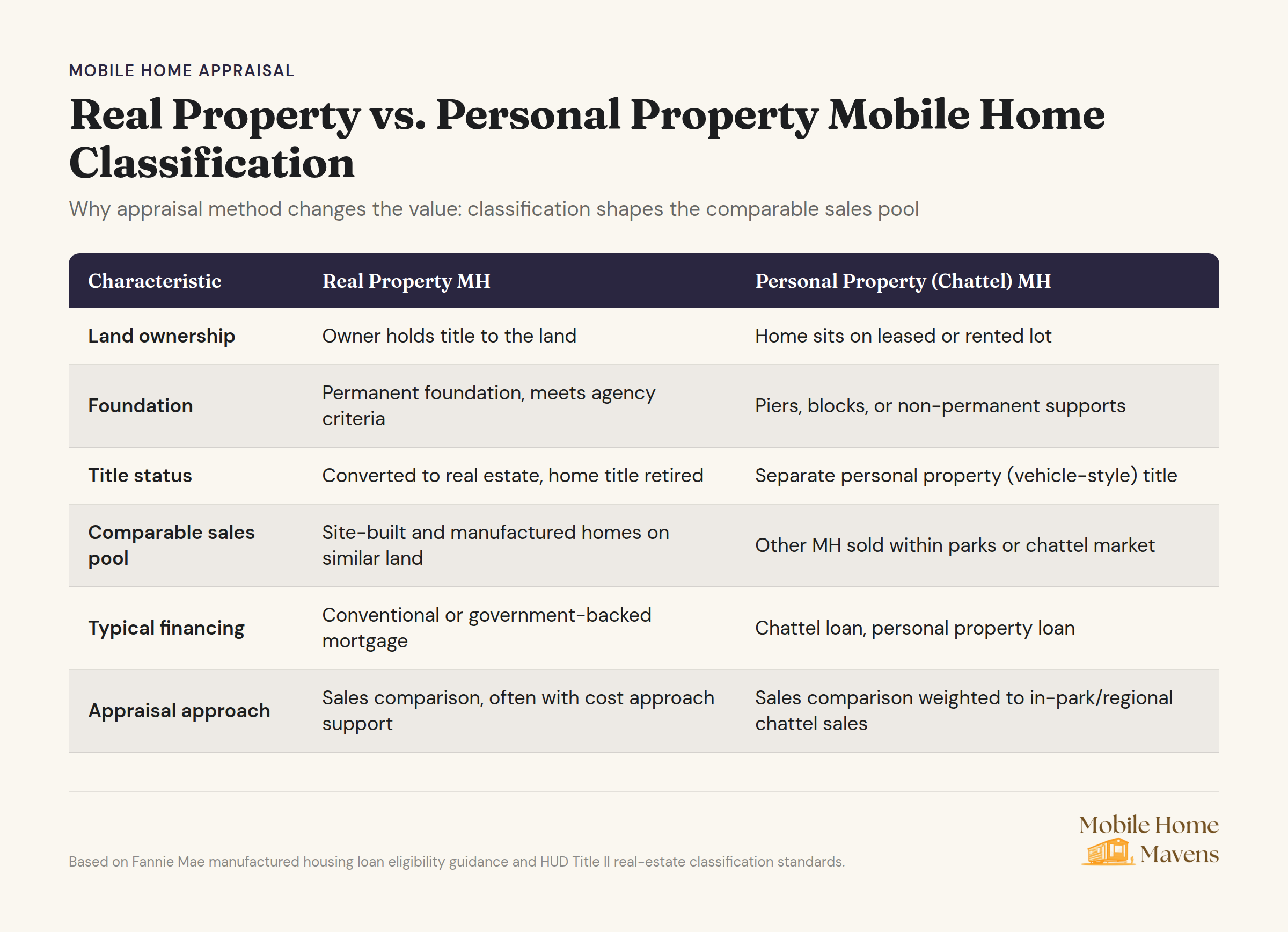
The single biggest driver of a value gap between two mobile home appraisals is whether the home was appraised as real property or as personal property (chattel). This isn't a minor technicality; it changes the entire pool of comparable sales and the methodology an appraiser applies.
A manufactured home permanently affixed to land the owner holds title to, properly titled as real estate, and meeting agency criteria is generally treated as real property. A home on a rented lot in a manufactured home community, or one that hasn't been converted to real estate under state law, is typically appraised as personal property, valued more like a vehicle than a house. Fannie Mae's guidance on manufactured housing loan eligibility lays out the requirements a home must meet to be treated as real estate for financing purposes, including permanent foundation criteria and titling requirements, and this distinction shapes which comparable sales pool an appraiser can even consider.
HUD applies a similar real-estate classification standard when a manufactured home is used as collateral for a Title II loan; a home that hasn't met the criteria for conversion to real property simply isn't eligible to be appraised or financed as one. If one appraiser identifies the home as real property (on owned land, permanently affixed) and another treats it as chattel (on leased land, retaining its personal-property title), the two will not be comparing it to the same universe of sales, and their conclusions will diverge accordingly.
Our personal property versus real estate guide breaks this distinction down in more detail if you're unsure which category applies to your home.
| Characteristic | Real Property MH | Personal Property (Chattel) MH |
|---|---|---|
| Land ownership | Owner holds title to the land | Home sits on leased or rented lot |
| Foundation | Permanent foundation, meets agency criteria | May be on piers, blocks, or non-permanent supports |
| Title status | Converted to real estate, home title retired | Separate personal property (vehicle-style) title |
| Comparable sales pool | Site-built and manufactured homes on similar land | Other manufactured homes sold within parks or chattel market |
| Typical financing | Conventional or government-backed mortgage | Chattel loan, personal property loan |
| Appraisal approach | Sales comparison, often with cost approach support | Sales comparison weighted heavily to in-park or regional chattel sales |
Comparable Sales Selection in a Thin Market
Manufactured home sales, especially within a single park or a specific region, are a thin market. There often aren't enough recent, closely matched sales to make comp selection mechanical, which means two appraisers can reasonably choose different comparables and still both be right.
One appraiser might pull three sales from within the same community over the past six months. Another, finding too few recent sales in that park, might reach into a neighboring community, widen the date range, or include a slightly different age or size band. Each of those choices is a defensible judgment call, not an error, and each will nudge the adjusted value in a different direction.
Pro tip: If you're comparing two reports and the values differ meaningfully, look first at the comparable sales grids. If one appraiser used comps from a different park, a different size class, or sales more than a year old while the other used tighter, more recent data, that alone can explain most of the gap.
Park Condition and Lot Rent Are Judgment Calls
When a manufactured home sits in a leased-land community, the park itself becomes part of the value equation. Management quality, the trend in monthly lot rent, age restrictions on residents, and the condition of shared amenities all affect how marketable that specific home is, and appraisers weigh these factors with judgment rather than a fixed formula.
An appraiser who spends time researching recent lot rent increases or a park's reputation for maintenance may adjust value downward for a community perceived as declining, while another appraiser working from less park-specific research might not apply the same adjustment. Neither approach is wrong on its face; it depends on how thoroughly each appraiser investigated the park's trajectory and how they translated that into a value conclusion.
Site Visit Differences Change the Condition Adjustment
Two site visits, even a few weeks apart, can turn up different observations. Skirting that was damaged during a storm, an addition or carport that wasn't disclosed in prior records, deferred maintenance on a roof or HVAC system, or simply a different day's lighting and access to crawl spaces can all lead one appraiser to note a defect the other missed.
Condition adjustments are inherently judgment-based. One appraiser might treat visible wear on skirting as a minor cosmetic issue worth a small deduction; another might treat it as a sign of broader deferred maintenance and adjust more aggressively. Both are following the evidence they gathered on their own inspection.
Intended Use Changes What "Value" Even Means
A lending appraisal, an estate appraisal, and an insurance appraisal are not answering the same question, even when they're describing the same home. Market value, the figure a lender typically wants, estimates what a buyer would pay in an arm's length sale. Replacement cost, often used for insurance purposes, estimates what it would cost to rebuild or replace the structure new. These are legitimately different numbers by design, not a discrepancy to be resolved.
Key takeaway: If you're comparing a report ordered for a mobile home loan appraisal against one ordered for insurance coverage or an estate settlement, expect the numbers to differ because the intended use, and the definition of value behind it, is different. That's not an error in either report.
Before assuming two appraisals conflict, check the intended use statement on the first page of each report. It's usually the fastest way to explain a gap that otherwise looks unexplainable.
What to Do If Two Appraisals Differ Significantly
A modest gap between two independent appraisals is expected. A large one is worth investigating methodically rather than assuming either report is wrong.
- Confirm the effective date. A report from 18 months ago reflects a different market than one completed last week, especially in fast-moving regional markets.
- Check land classification. Verify both appraisers identified the home consistently as real property or personal property; a mismatch here explains most large gaps.
- Confirm intended use. Make sure you're not comparing a market value opinion against a replacement cost estimate.
- Review the comparable sales grids. Look for wildly different comps, dates, or locations between the two reports.
- Request a review appraisal. A qualified appraiser can review both reports and identify which assumptions drove the difference, or commission a third independent opinion if the stakes justify it.
Classification and intended use decisions can carry real legal and lending consequences, so when you're unsure which category applies to your situation, confirm with your lender or an attorney before relying on either report. If you need a fresh, independent opinion to resolve a dispute between two existing appraisals, our team can request a mobile home appraisal scoped specifically to settle the question at hand.