
Blog
How New UAD 3.6 Appraisal Standards Could Affect Manufactured Home Valuations
UAD 3.6 overhauls how Fannie Mae and Freddie Mac appraisals are reported, but it only touches manufactured homes financed as real property through a conventional mortgage. Here's how to tell which bucket your home falls into and what actually changes in the report.
Fannie Mae and Freddie Mac are rolling out the biggest change to residential appraisal reporting in decades, and manufactured home owners are understandably confused about whether it applies to them. The short answer: it depends entirely on how your home is financed and titled, not on the fact that it's manufactured housing. This guide walks through what the new Uniform Appraisal Dataset (UAD) 3.6 standard actually changes, who it governs, and what stays exactly the same for owners whose homes sit outside the conventional mortgage system.
What Is UAD 3.6, and Why Does It Matter for Manufactured Homes?
UAD 3.6 is a redesigned data standard that Fannie Mae and Freddie Mac use to collect appraisal information for loans they purchase. Instead of a dozen separate static forms, appraisers now fill out a single dynamic Uniform Residential Appraisal Report (URAR) that expands or contracts its fields based on the property's actual characteristics. Narrative addenda give way to structured data fields, dropdowns, and checkboxes, and the completed appraisal is delivered to the Uniform Collateral Data Portal (UCDP) as a package containing an XML data file, a human-readable PDF, and a folder of property images.
The form that manufactured home owners knew as Form 1004C, also called Freddie Mac Form 70B, is being retired as a standalone document. That does not mean the manufactured-housing data it collected disappears. The HUD certification and data plate details, serial or VIN number, foundation type, utilities, construction characteristics, site value, and cost approach all move into the new dynamic URAR instead, as Freddie Mac's forms redesign guidance confirms.
If your manufactured home is financed with a conventional mortgage that Fannie Mae or Freddie Mac will purchase, this redesign changes the paperwork your appraiser fills out. If it's not, the redesign is largely irrelevant to you, which brings us to the distinction that actually matters.
The Scope Distinction Most Owners Miss
UAD 3.6 only governs appraisals delivered to Fannie Mae or Freddie Mac through UCDP for conventional, GSE-eligible mortgages. It does not apply to every manufactured home appraisal performed in the country.
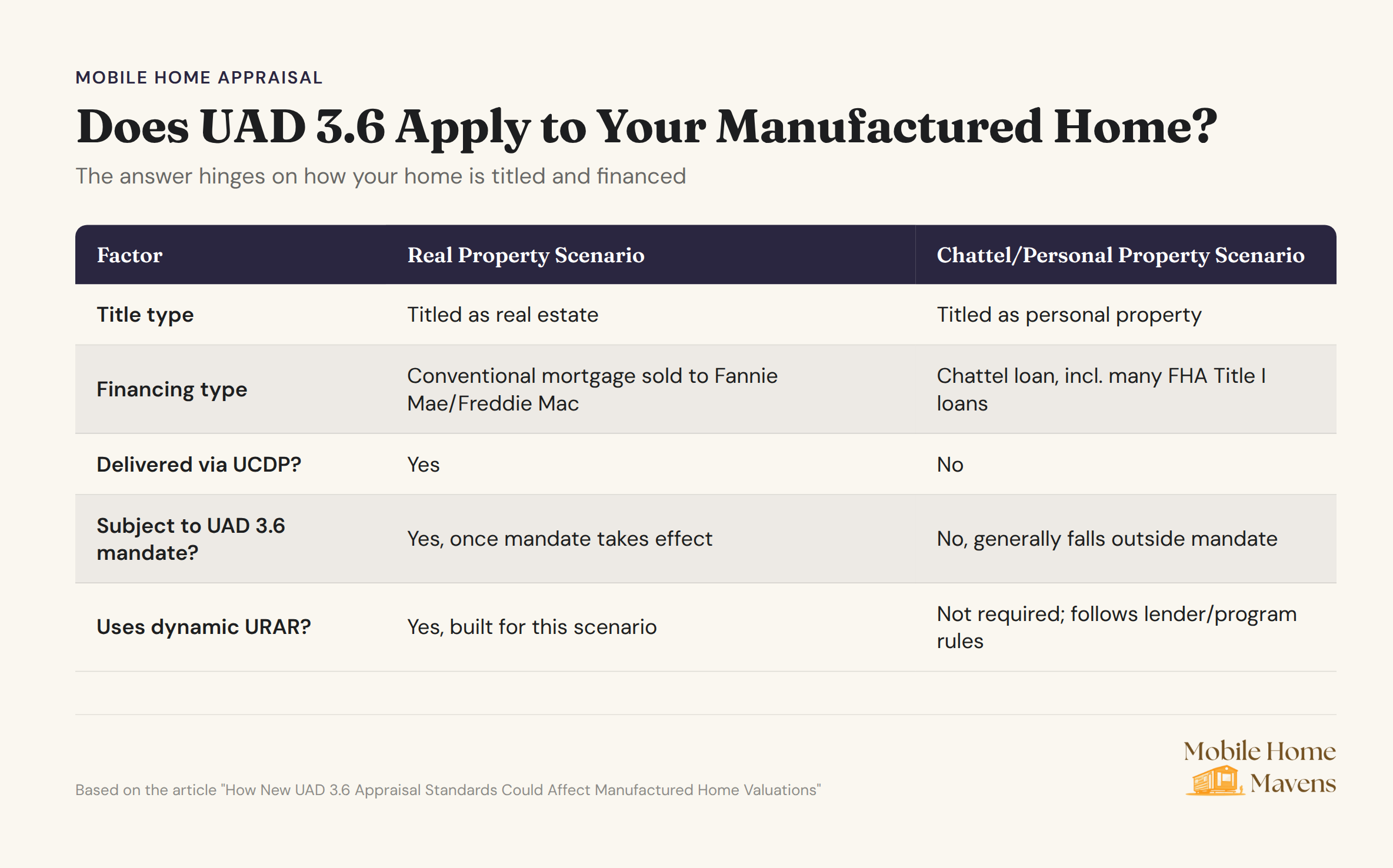
Whether your home falls under the new standard comes down to one question: is your home titled and financed as real property, or as personal property (chattel)?
- Real property, conventional mortgage: If your manufactured home is permanently affixed to land you own, titled as real estate, and financed with a conventional mortgage that will be sold to Fannie Mae or Freddie Mac, your appraisal will be prepared under UAD 3.6 once the mandate takes effect. This is the scenario the dynamic URAR is built for.
- Chattel or personal-property financing: If your home is financed as personal property, including many FHA Title I loans, it is not delivered to the GSEs through UCDP and generally falls outside the UAD 3.6 mandate. Those appraisals follow whatever requirements your lender or loan program sets, which may or may not adopt similar structured reporting on its own.
This classification question is the same one that determines how a manufactured home is taxed, titled, and insured, and it trips up more owners than any appraisal form change ever will. If you are not sure which bucket your home falls into, our guide on whether a mobile home counts as personal property or real estate walks through the qualifying factors in detail. Confirming this upfront saves a lot of confusion when a lender mentions a new appraisal report and you are trying to figure out whether it affects you.
What Actually Changes in the Appraisal Report
For homes that do fall under UAD 3.6, the changes are about documentation depth and consistency, not a new valuation formula. Nothing in the redesign tells an appraiser to add or subtract a fixed percentage for manufactured construction. Instead, the dynamic URAR captures more granular data in a handful of specific areas.
Construction method gets called out explicitly. The report now requires appraisers to identify whether a dwelling meets the formal definition of manufactured housing or whether it should be reported as site-built, which covers modular and panelized homes whose major components were assembled at the permanent site. That distinction matters because a manufactured home should be compared against other manufactured homes in the sales comparison approach, not lumped in with modular housing simply because both arrived from a factory.
Condition and quality ratings get more detailed. UAD 3.6 keeps the familiar C1 through C6 condition scale and Q1 through Q6 quality scale, but it refines the definitions and asks for separate ratings where interior and exterior condition differ materially. For a manufactured home with an older roof but a renovated interior, or a newer home with deferred exterior maintenance, that distinction can now show up clearly in the data rather than getting buried in a narrative paragraph.
Comparable sale requirements are spelled out. The manufactured-housing guidance built into UAD 3.6 requires at least two closed comparable sales of manufactured homes, and where the subject is a single-section, multi-story, or two-to-four-unit manufactured home, at least one comparable with that same configuration when one is available in the market, according to Fannie Mae's UAD 3.6 appraiser guidance. A supported cost approach is also required, addressing manufactured-home construction and site-cost components specifically.
Accessory dwelling units and multi-unit configurations get their own fields. The redesign expands which manufactured-housing scenarios can even be reported for agency financing, including standard manufactured homes with one qualifying ADU, MH Advantage homes with multiple ADUs up to four total dwelling units, and two-to-four-unit manufactured properties, provided each component is classified as real property. These are eligibility and reporting expansions, not value guarantees; comparable sales and local market acceptance still drive the number an appraiser concludes.
Measurement gets standardized. ANSI measurement standards now apply to manufactured housing the same way they apply to detached site-built homes, which should improve consistency in how above-grade area, finished area, and noncontinuous finished space get reported. If your home's measured area changes under the new standard, that reflects a measurement correction, not evidence that the home's market value moved.
When These Changes Take Effect
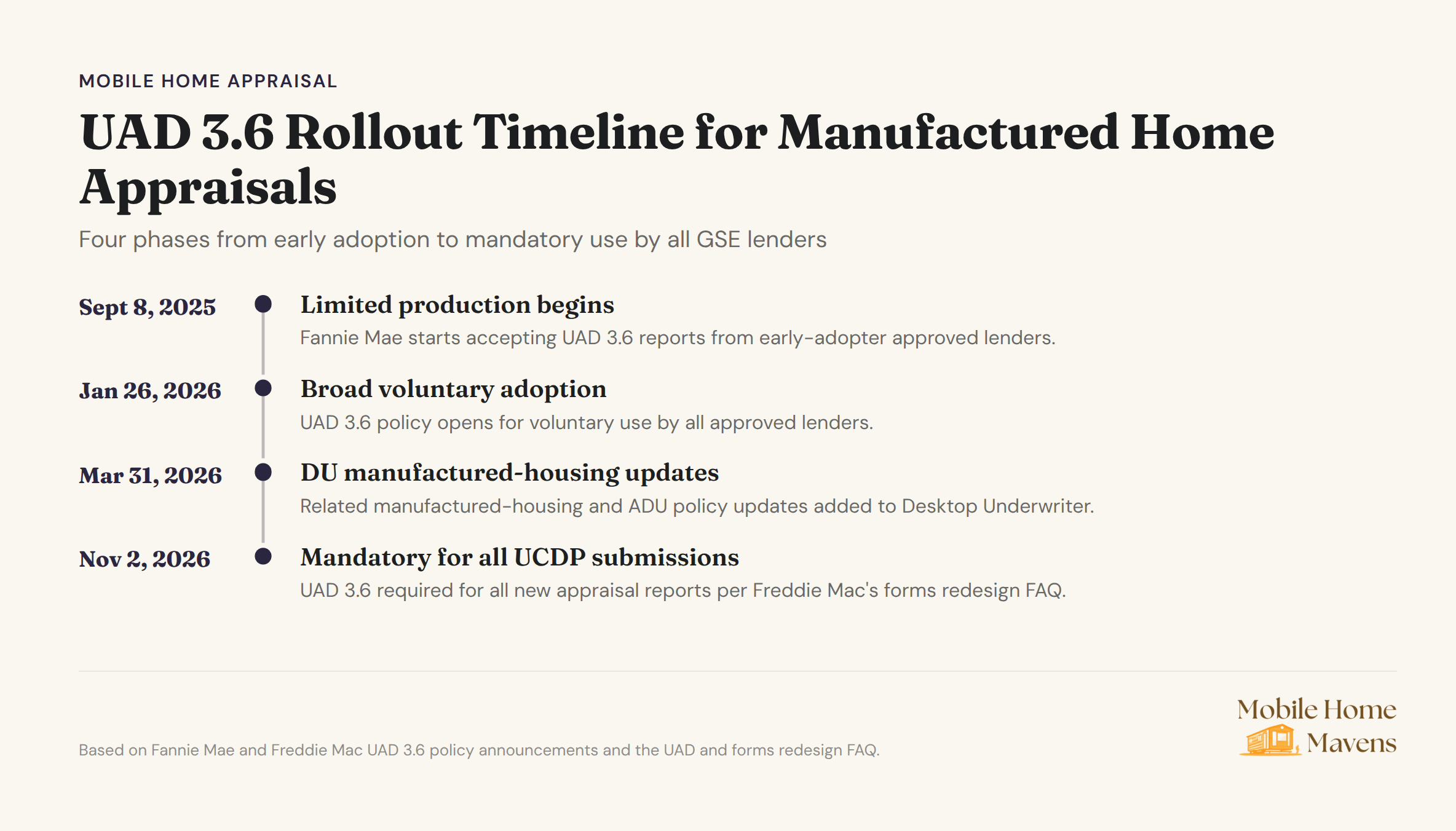
The rollout is happening in phases, and the dates matter if you are planning a refinance or sale around this transition.
- September 8, 2025: Fannie Mae began accepting UAD 3.6 reports from lenders approved for early, limited-production adoption.
- January 26, 2026: Fannie Mae's UAD 3.6 policy became available for broad, voluntary use by all approved lenders.
- March 31, 2026: Related manufactured-housing and ADU policy updates were made available in Fannie Mae's Desktop Underwriter system.
- November 2, 2026: UAD 3.6 becomes mandatory for all new appraisal reports submitted to the Uniform Collateral Data Portal, per Freddie Mac's UAD and forms redesign FAQ.
Between now and the November 2026 mandatory date, you may encounter either the legacy forms or the new dynamic URAR depending on your lender's adoption timeline. After that date, any manufactured home appraisal headed for a conventional loan sale to the GSEs will use the new format.
What Stays the Same, No Matter the Form
It is worth being clear about what UAD 3.6 does not touch. Every manufactured home appraisal, old form or new, still depends on the same fundamentals our appraisers have always verified:
- The HUD certification label and data plate, which confirm the home was built to the federal manufactured home construction code.
- A foundation certification where required, documenting whether the home sits on a permanent foundation that supports real-property classification.
- The home's classification as real property or personal property, which drives everything from financing eligibility to which appraisal requirements apply in the first place.
- A market-supported sales comparison approach, reconciled against cost and, where relevant, income data.
These fundamentals are prepared in accordance with the Uniform Standards of Professional Appraisal Practice (USPAP), the standard our appraisers follow regardless of which form or dataset a particular loan program requires.
What This Means If You're Refinancing or Selling
If you're refinancing or selling a manufactured home that is titled as real property and financed through a conventional mortgage, expect a more detailed, data-rich dynamic URAR appraisal once your lender adopts UAD 3.6, and certainly after the November 2026 mandatory date. The report will likely include more granular condition notes, explicit construction-method identification, and clearer handling of any ADUs or site improvements than the old 1004C provided.
If your home is financed as chattel or personal property, this particular overhaul does not change your appraisal process. Your lender's own requirements still govern the report, so it's worth confirming directly with them rather than assuming the GSE timeline applies to your loan. Either way, if you're working through a loan collateral appraisal or trying to establish your home's value for refinancing, our mobile home appraisal for loan collateral service can tell you upfront which standards and documentation your specific financing situation requires.
Get an Appraisal That Matches Your Financing Path
UAD 3.6 is a reporting overhaul, not a new way of valuing manufactured homes, and it only reaches the conventional, real-property side of the market. The fastest way to avoid confusion is to confirm your home's classification and financing type before the appraisal is ordered, not after. Our team works with manufactured home owners, lenders, and attorneys every day to determine which standards apply and deliver a report built for its intended use. Reach out through our manufactured home appraisal services to get started.
This article is provided for general informational purposes only and does not constitute legal, tax, or financial advice. Readers should consult their lender or a qualified professional regarding their specific financing and appraisal requirements.