
Blog
Why Tiny House Appraisal Comparables Are Scarce and What Lenders Accept Instead
Tiny house appraisal comparables are hard to find because few similar-size homes sell. This guide explains how appraisers fill the gap, what lenders accept for foundation and wheeled units, and which documents to gather first.
Published
Key Takeaways on Tiny House Appraisal Comparables
Here is what tiny home owners and buyers need to know about tiny house appraisal comparables:
- Scarce comparables: Tiny house appraisal comparables are scarce because few homes of similar size sell, and large-home sales require size adjustments that reviewers distrust.
- Gap-filling methods: Appraisers fill the gap with the cost approach, RV and dealer data, a wider search area, older sales with time adjustments, and listing data. Our tiny home appraisal service uses these methods in a USPAP-compliant report.
- Foundation-built homes: A foundation-built tiny home that qualifies as real property still needs comparables of similar size to support value under mortgage programs.
- Units on wheels: An RVIA-certified tiny home on wheels typically moves through RV, chattel, or personal loans, because the unit is personal property that depreciates.
- Lender decision: The lender decides whether an appraisal is acceptable. A complete document package and a clear marketability case give the lender what it needs to decide.
Tiny house appraisal comparables are the weak point in most tiny home financing files. A lender wants completed sales of similar homes, and the market rarely produces them. This guide covers why the data is thin, how appraisers work around it, what lenders accept, and the documents owners can assemble before the appraisal starts.
Why Are Tiny House Appraisal Comparables So Hard to Find?
Tiny house appraisal comparables are hard to find because the market produces very few closed sales of homes with matching size, construction, and legal classification. The International Residential Code Appendix Q defines a tiny house as a dwelling of 400 square feet or less, excluding lofts. Most neighborhoods record only a handful of sales in that size range, if any.
Several conditions combine to thin the data:
- Few sales of similar size: Tiny homes sell privately, through builders, or through specialty listing sites. Many of those transactions never reach the MLS or public records.
- Size-adjustment problems: A 1,800 square foot house that sold next door is a poor comparable for a 300 square foot home. The size adjustment becomes so large that the sale stops measuring the subject.
- Location and legal differences: A tiny home on a foundation, a park model in an RV community, and a unit on wheels sit in different markets. Fannie Mae's comparable sales guidance requires comparables with similar physical and legal characteristics to the subject.
- Thin demand data: A small buyer pool makes marketing times longer and price patterns harder to read.
Adjustment size matters because reviewers examine it closely. The OCC's appraisal examination guidance states that comparables should be physically and economically comparable and that adjustment amounts must be explained, including how they were determined. A comparable that needs a very large adjustment fails that test.
Example: A 320 square foot tiny home on a permanent foundation sits in a county where the nearest sale of a home under 600 square feet closed 3 years ago, 40 miles away. The only recent sales nearby are 1,500 square foot houses. Neither set supports a clean sales comparison, so the appraiser needs other evidence.
Mobile Home Mavens appraises the home itself, not the land. Lenders that finance a foundation-built tiny home as real property often add a separate real-estate appraisal for the site. Our mobile home appraisal for loan collateral work follows the same split between the structure and the land.
How Do Appraisers Value a Tiny Home Without Close Comparables?
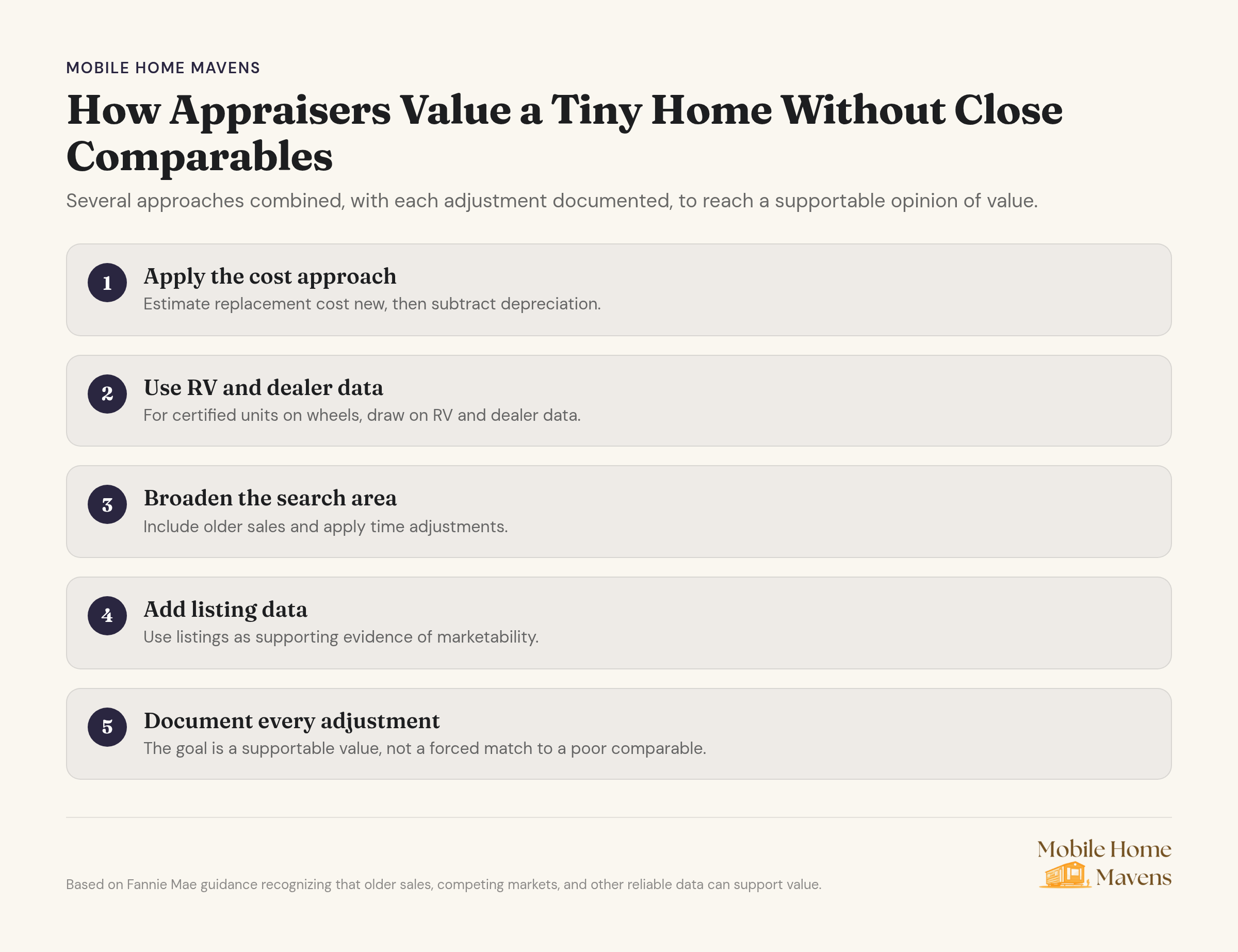
Appraisers value a tiny home without close comparables by combining several approaches and documenting each adjustment. The goal is a supportable opinion of value, not a forced match to a sale that does not fit. Fannie Mae's guidance recognizes that an appraiser unable to find recent sales of the same design can still support value with older sales, competing markets, and other reliable data.
Cost Approach: Replacement Cost New Less Depreciation
The cost approach estimates what it would cost to build the home today, then subtracts depreciation. Replacement cost new covers materials, labor, builder overhead, and profit. Depreciation covers physical wear, functional shortcomings, and external factors.
The cost approach carries extra weight on tiny homes because builder invoices and itemized costs exist for most units. Mobile Home Mavens uses the cost approach as a primary or supporting method when sales data is sparse. The method works best when the owner supplies documented build costs.
RV and Dealer Data for Certified Units on Wheels
A unit certified by RVIA and built to NFPA 1192 competes in the RV market, not the housing market. Appraisers pull dealer retail prices, manufacturer price sheets, and comparable RV sales for these units. RVIA member manufacturers are inspected roughly every 8 weeks, which gives the certification weight with RV lenders.
RV and dealer data supports the market value of the unit as a vehicle-type asset. The data does not support a real-estate value, because the unit is not real property.
Broader Search Area and Older Sales With Adjustments
An appraiser widens the geographic search when the local market has no data. Sales from competing regions are acceptable when the report explains why those markets compete with the subject. Older sales enter the analysis with market-supported time adjustments.
Every step adds explanation to the report. The appraiser states why each sale was chosen, what was adjusted, and how the adjustment was measured.
Listing and Offering Data
Active listings and asking prices show what sellers expect, not what buyers pay. Appraisers treat listing data as supporting evidence of marketability, not as closed-sale proof. Fannie Mae permits listings and under-contract sales as supplemental exhibits when closed sales are difficult to locate.
What Lenders Accept for a Tiny House Appraisal
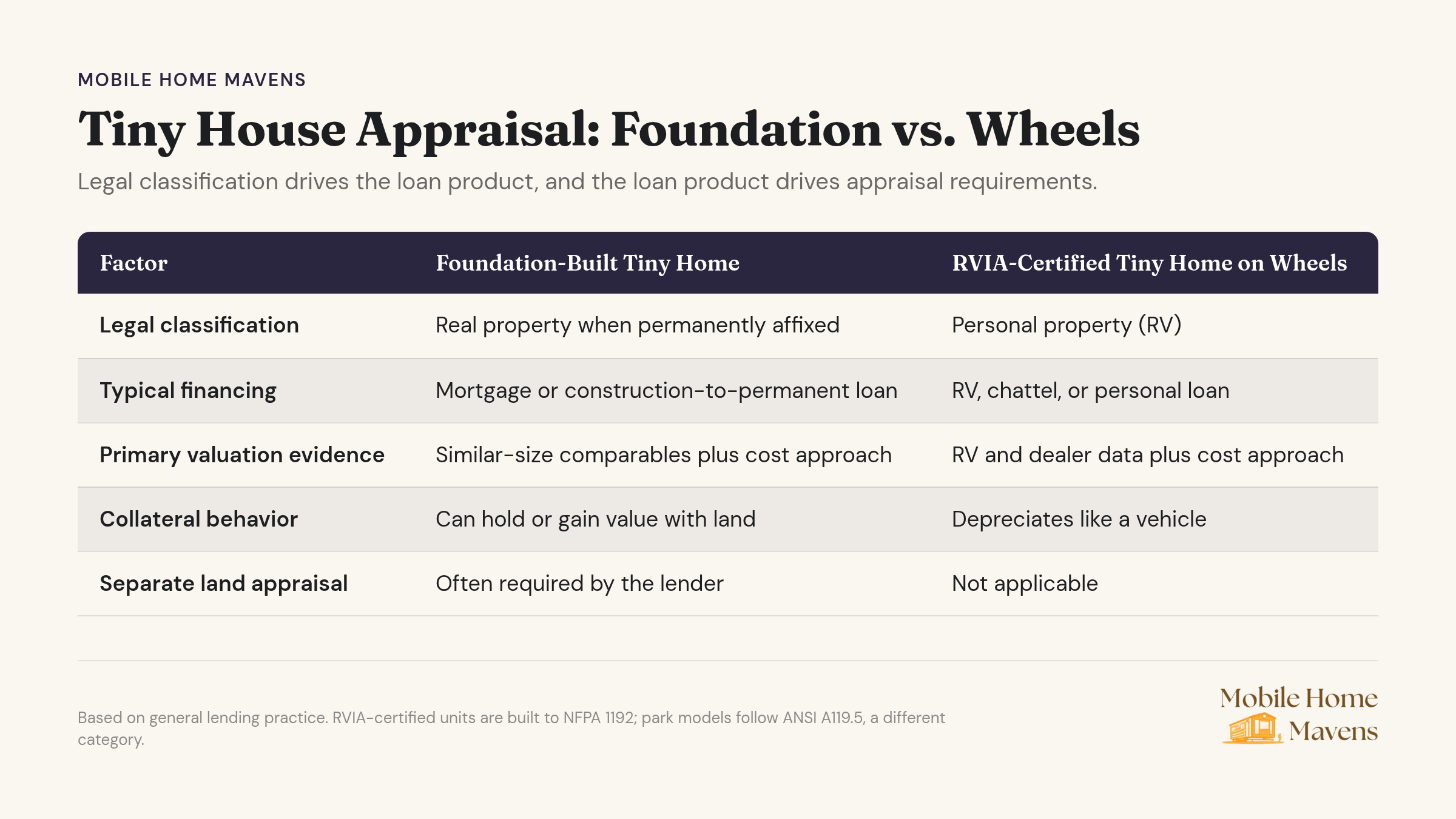
Lenders accept different evidence depending on whether the tiny home is real property or personal property. The legal classification drives the loan product, and the loan product drives the appraisal requirements. A tiny home on a permanent foundation, on owned land, can qualify for a mortgage. A tiny home on wheels typically cannot.
The table below compares the two common paths for a tiny home appraisal, based on general lending practice:
| Factor | Foundation-Built Tiny Home | RVIA-Certified Tiny Home on Wheels |
|---|---|---|
| Legal classification | Real property when permanently affixed | Personal property (RV) |
| Typical financing | Mortgage or construction-to-permanent loan | RV, chattel, or personal loan |
| Primary valuation evidence | Similar-size comparables plus cost approach | RV and dealer data plus cost approach |
| Collateral behavior | Can hold or gain value with land | Depreciates like a vehicle |
| Separate land appraisal | Often required by the lender | Not applicable |
Fannie Mae sets no general minimum square footage for non-manufactured homes. The same guidance still requires comparables of similar size to support the value and acceptability of the property. A foundation-built tiny home therefore needs size-appropriate evidence, not a waiver of the comparable requirement.
A unit on wheels follows a different route. RVIA-certified units built to NFPA 1192 are treated as recreational vehicles, so financing runs through RV, chattel, or personal loans. Our guide on what a chattel appraisal is explains how appraisals work for homes financed as personal property.
Watch out: A tiny home built to ANSI A119.5 as a park model is a different category from an NFPA 1192 unit. The certification label determines the market the appraiser studies, so confirm which standard applies before ordering a report.
Marketability and Tiny House Appraisal Comparables
Marketability is the question lenders raise most often on tiny home loans. A lender asks whether the collateral can be resold at a predictable price if the borrower defaults. Thin comparable data makes that question harder to answer.
An appraisal addresses marketability with evidence, not assertion. The report documents days on market for similar units, dealer demand, the buyer pool, and the strength of local zoning acceptance. Zoning matters because a tiny home that cannot legally be occupied in its county has a much smaller buyer pool.
The lender decides whether the evidence is enough. Prepared in accordance with USPAP, an appraisal gives the lender a defensible, standards-compliant opinion of value, and the lender's own underwriting rules decide the loan outcome.
Tiny House Appraisal Documentation Checklist
A tiny house appraisal relies heavily on owner-supplied records, because the market data is thin. Complete records shorten the appraisal and strengthen the cost approach. Fees follow scope, so incomplete records and unusual construction add analysis time. Mobile Home Mavens quotes a fixed fee after scoping the assignment, before work begins.
Gather the following documents before requesting a tiny house appraisal:
- Builder invoices and itemized cost breakdown: These support replacement cost new in the cost approach.
- Receipts for materials, appliances, and fixtures: Receipts document owner-built or owner-upgraded components.
- Plans and specifications: Floor plans, elevations, and structural drawings define size, layout, and construction quality.
- Certifications: Include the RVIA seal, NOAH certification, or ANSI A119.5 documentation, whichever applies.
- VIN and title: A unit on wheels needs its vehicle identification number and title to establish personal property status.
- Foundation or engineer certification: A foundation-built home needs proof of permanent attachment and structural adequacy.
- Permits and inspection records: Building, electrical, plumbing, and occupancy permits show the home is legally built and occupied.
- Land documents: Deeds, leases, or park agreements establish whether the home sits on owned or leased land.
- Utility documentation: Records of water, sewer or septic, electric, and heating connections show the home is habitable.
- Photographs: Exterior, interior, mechanical systems, and foundation or chassis photos show condition and quality.
- Prior sales or listings of similar units: Any sale, listing, or offer you know of gives the appraiser direct market evidence.
- Dealer price sheets: Manufacturer and dealer pricing anchors the market value of certified units on wheels.
Pro tip: Photograph the construction details that stay hidden after finishing, such as framing, insulation, and wiring, while the walls are still open. Those photos support build quality in the cost approach.
Preparing a Tiny House Appraisal Lenders Can Underwrite
Tiny house appraisal comparables will stay scarce while the market stays small. The practical response is a report that combines the cost approach, relevant RV or retail data, and explained adjustments, backed by a complete document package. Our appraisers hold credentials with leading organizations such as the ASA, ISA, and AAA, and every report is prepared in accordance with USPAP.
Owners who match the legal classification of the home to the right loan path, and who assemble the documents above, give their lender the strongest case. Start with a request for a tiny home appraisal when your records are ready, or contact Mobile Home Mavens to scope the assignment first.
This article is provided for general informational purposes only and does not constitute legal, tax, or financial advice. Lending requirements vary by lender and loan program, and the lender decides whether an appraisal is acceptable. Readers should consult a qualified attorney, CPA, or lender regarding their specific circumstances.