
Blog
Single-Wide vs Double-Wide Mobile Home Appraisals: What Changes in the Process
Single-wide and double-wide manufactured homes are appraised under the same federal construction code, but the comparable sales pool, size ranges, and intake questions differ. Here's exactly what changes in a single wide vs double wide appraisal and what stays the same.
A single-wide and a double-wide manufactured home are built to the identical federal construction standard, inspected the same way, and valued using the same three approaches to value. What changes between them is narrower than most owners expect: how many factory-built sections the home has, how appraisers select comparable sales, and how scarce those comparables can be depending on your local market. This guide walks through exactly what shifts in a single wide vs double wide appraisal, and what doesn't.
If you're preparing to have your home appraised, our mobile home appraisal service handles both configurations, along with the paperwork questions that tend to surface once the appraiser is on site or reviewing your records remotely.
What Single-Wide and Double-Wide Actually Mean
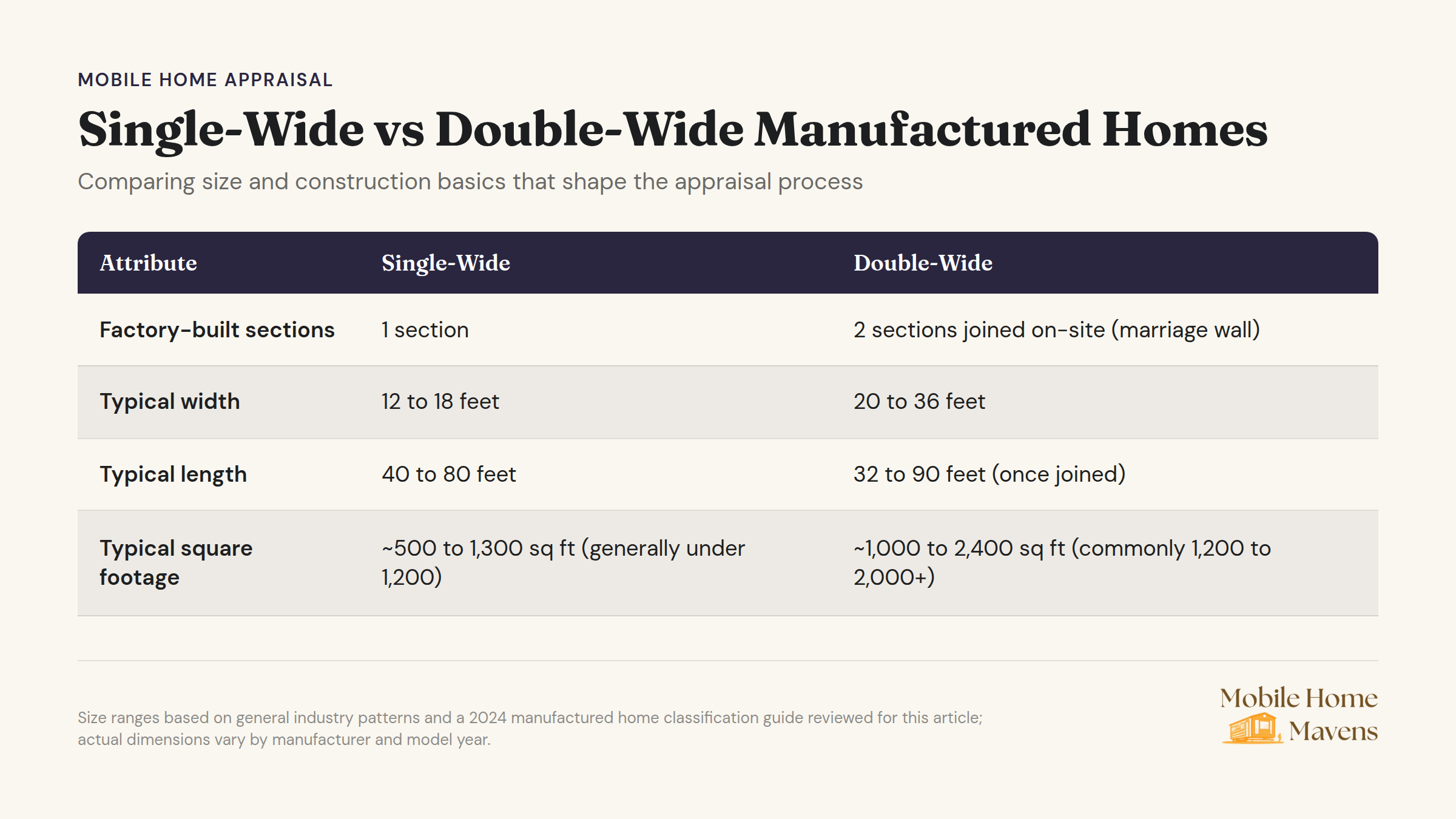
A single-wide manufactured home is delivered to the site as one complete factory-built section. A double-wide is delivered as two sections that are joined on site along a seam sometimes called the marriage wall. Both are manufactured homes under federal law; the section count is the entire distinction.
Size ranges vary by manufacturer and model year, but general industry patterns hold up well enough to be useful for orientation:
- Single-wide: typically 12 to 18 feet wide and 40 to 80 feet long, producing roughly 500 to 1,300 square feet of living area.
- Double-wide: typically 20 to 36 feet wide and 32 to 90 feet long once joined, producing roughly 1,000 to 2,400 square feet of living area.
A county classification guide reviewed in preparing this article describes singlewide homes as generally under 1,200 square feet and doublewide homes as commonly running from 1,200 up to over 2,000 square feet, which lines up with what appraisers see in the field (2024 manufactured home classification guide). Neither figure is a rule; a well-appointed single-wide can outsize an older or smaller double-wide. Square footage, not the single-wide or double-wide label itself, is what an appraiser measures and reports.
Same Federal Construction Code, Different Section Count
Here is the point owners misunderstand most often: single-wide and double-wide homes are not built to different tiers of quality or different codes. Every manufactured home built after June 15, 1976 (single-section or multi-section) must meet the same HUD Manufactured Home Construction and Safety Standards, commonly called the HUD Code. A double-wide is not a "better-built" category; it is simply assembled from more than one section.
Appraisers confirm this construction standard, and the home's configuration, through two physical documents:
- The HUD certification label: a metal plate (sometimes called a red tag) affixed to the exterior of each section. A single-wide has one label. A double-wide has two, one per section, which is how an appraiser confirms the configuration even before measuring.
- The HUD data plate: typically located inside a cabinet or utility area, listing the manufacturer, model, date of manufacture, and design specifications used to confirm the home meets HUD construction requirements, per federal guidance on manufactured housing standards (HUD manufactured housing guidance).
When these labels are missing or illegible, which happens more often on older single-wides than newer double-wides, the appraiser has to work harder to document construction date and specifications, and that added research is a legitimate factor in scoping the assignment. It is not evidence that the home fails to meet code.
How Comparable Sales Selection Differs
This is where single-wide and double-wide appraisals genuinely diverge. Both configurations require the appraiser to use manufactured home comparable sales rather than site-built comps as the primary evidence of value, but the pool each draws from is treated differently.
Secondary-market guidance calls for a minimum of two manufactured home comparable sales for any manufactured home appraisal, single-wide or multi-section (Fannie Mae's factory-built housing requirements). For single-width homes specifically, that guidance goes further: at least one comparable must be a closed sale of the same single-width configuration when one is available, and if no closed single-width sale exists nearby, an active listing or under-contract sale of a single-wide can be used as supplemental evidence of marketability. Multi-width (double-wide and larger) homes carry no equivalent same-configuration requirement; their two required manufactured home comps can be drawn more broadly, with a third comp allowed to be site-built or modular housing.
Fannie Mae's own product matrix documentation formally separates single-width and multi-width as distinct categories for underwriting and pricing purposes, which is a strong signal that the market, not just the appraisal form, treats them as different buyer segments (Manufactured Housing Product Matrix). Loan-delivery systems even track manufactured home width type as its own coded field (manufactured housing pricing and delivery requirements).
In practice, this means:
- Buyers shopping for single-wides tend to be a different pool than buyers shopping for double-wides, so sales data doesn't mix cleanly between the two.
- In markets that have shifted toward larger, multi-section homes over the past decade, closed single-wide sales can be genuinely scarce, forcing appraisers to widen their search radius or lean on active listings as supplemental support.
- Double-wide comps are usually easier to find in growing manufactured home communities, simply because more of that inventory has been built and sold recently.
Watch out: A thin comparable pool is not a defect in the home. It's a market condition, and a competent appraiser will document it and explain how it was addressed rather than force a comparison that doesn't hold up.
Both configurations are reported on the same manufactured home appraisal form, and both require a cost approach reviewed alongside the sales comparison, so the reporting format itself does not change with width, only the sourcing of the comps used within it (appraising manufactured homes).
Chattel vs Real Property: Not a Width Question
A common assumption is that single-wides are always personal property (chattel) and double-wides are always real estate. That's not how the classification works. Whether a manufactured home is titled as chattel or converted to real property depends on land ownership, foundation type, and title status, not on how many sections the home has.
A single-wide permanently affixed to a permanent foundation on land the owner holds title to can be classified as real property. A double-wide sitting on leased land in a manufactured home community, still carrying a DMV or state title, is almost always chattel regardless of its size. Our team has appraised both configurations as personal property specifically because the land underneath was leased rather than owned, which is the deciding factor far more often than square footage.
If you're unsure which category applies to your situation, our guide to chattel appraisals for mobile homes breaks down the criteria in more depth, and our mobile home appraisal for bonded title page covers what changes when the title itself is in question.
How This Changes Our Intake Process
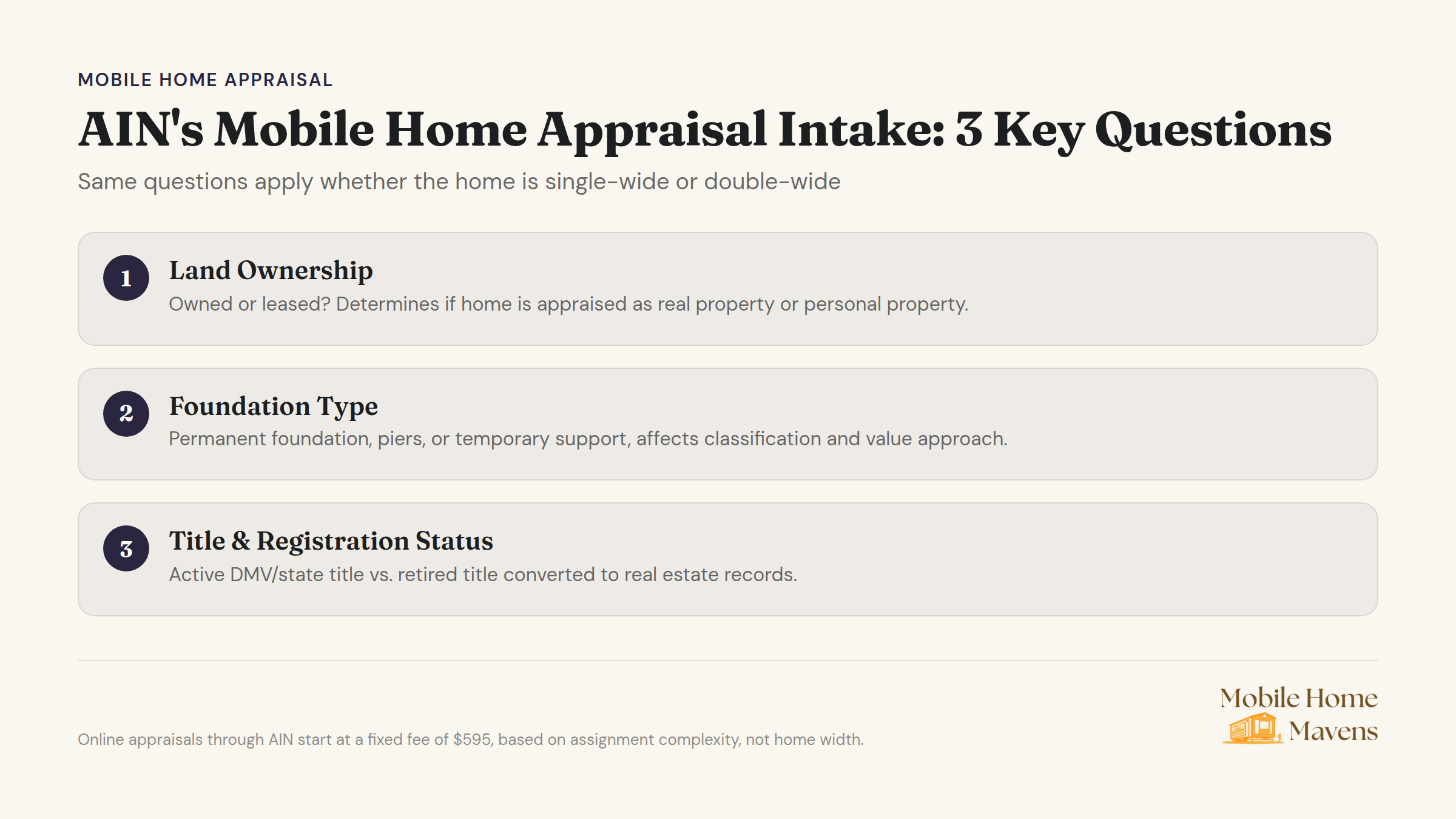
Because the value driver isn't width, the intake questions we ask are the same for single-wide and double-wide homes. Before scoping any assignment, we ask about:
- Land ownership: whether the homeowner owns the land under the home or leases the lot, since this determines whether the home is appraised as real property or personal property.
- Foundation type: whether the home sits on a permanent foundation, piers, or a temporary support system, which affects both the classification question and which value approaches apply.
- Title and registration status: whether the home still carries a DMV or state vehicle-style title, or whether the title has been retired and the home converted to real estate records.
These answers shape the assignment more than the section count does. A single-wide on owned land with a retired title and a permanent foundation may be appraised much like a small site-built home. A double-wide on leased land with an active DMV title is treated as personal property, following the same intake path we'd use for a single-wide in the same situation.
Our online mobile home appraisals are quoted as a fixed fee starting at $595, set before work begins based on the scope of the assignment rather than billed by the hour. The fee reflects the complexity of the assignment (documentation quality, whether HUD labels are legible, how many comparable sales require research) rather than the home's width or its market value.
What Doesn't Determine Value
It's worth being direct about a common misconception: there is no fixed premium or discount that applies simply because a home is a single-wide instead of a double-wide. Value differences between the two come down to square footage, condition, age, upgrades, lot or land factors, and how many comparable sales are actually available in that market at that time. A well-maintained, updated single-wide in a market with strong single-wide demand can outperform a neglected double-wide nearby. Appraisers report what the data supports, not a categorical assumption based on section count.
Getting the Right Comparable Sales for Your Home
The practical takeaway for owners is this: if your home is a single-wide, ask your appraiser how they're sourcing comparables, since a thin local pool for single-wides is common and needs to be documented, not glossed over. If it's a double-wide, the process is more likely to draw on a deeper local comp base, but the same construction and classification standards still apply underneath.
Whether you're preparing for a sale, a refinance, insurance coverage, or an estate matter, our request an appraisal page is the place to start; we'll ask the land ownership, foundation, and title questions up front so the assignment is scoped correctly from day one, regardless of whether your home is a single-wide or a double-wide.
This article is provided for general informational purposes only and does not constitute legal, tax, or financial advice. Readers should consult a qualified attorney or CPA regarding their specific circumstances.