
Blog
How Estate Executors Use Mobile Home Appraisals to Establish Date-of-Death Value
A mobile home date of death appraisal value sets the number an executor reports on the estate tax return and the basis an heir carries forward, so it needs independent support, not a guess. This guide explains the IRS rules behind that number and how it is documented.
When someone dies owning a manufactured or mobile home, the executor has to put a number on it, usually sooner than they'd like. That number does more work than most people realize. It can determine whether the estate owes tax, what an heir's income tax basis looks like years down the road, and whether siblings splitting an inheritance trust the math. This guide walks through what a date-of-death appraisal actually establishes and why it needs to come from an independent appraiser rather than a guess written into an accounting.
Our probate appraisal service exists specifically for this situation: a personal representative who needs a defensible, dated value for a mobile or manufactured home that's part of someone's estate.
What Does "Date-of-Death Value" Mean for a Mobile Home?
Date-of-death value is the fair market value of the home as of the exact day the owner died, not the day it's inspected, listed, or eventually sold. Treasury regulations define fair market value as the price a willing buyer would pay a willing seller, with neither party under pressure to act and both having reasonable knowledge of the relevant facts, as of that specific date (26 C.F.R. 20.2031-1).
That timing detail matters more for a mobile home than people expect. Manufactured housing depreciates differently than site-built real estate, and values can shift in a matter of months depending on park conditions, local inventory, and the unit's age. An appraiser working a date-of-death assignment has to reconstruct what the market looked like on that day, using comparable sales and condition data from around that time, not current listings.
Why the Date-of-Death Number Controls the Heir's Future Tax Basis
Under the step-up-in-basis rule, an heir's income tax basis in inherited property generally resets to the property's fair market value on the date of death, or on the alternate valuation date if the executor validly elects it. That new basis becomes the heir's starting point for calculating gain or loss whenever they eventually sell the home.
This creates a direct link between the executor's appraisal and the heir's tax return, sometimes years later. For estates required to file a federal estate tax return, the beneficiary's basis generally cannot exceed the value reported on that return for federal estate tax purposes. In practice, that means the figure the executor reports today becomes the ceiling the heir lives with when they eventually sell, refinance, or gift the home. An executor who lowballs the value to minimize estate tax exposure may be handing the heir a larger capital gains bill later. An executor who inflates it risks exactly the opposite problem on the estate side.
Key takeaway: The date-of-death value isn't just a line item for the estate tax return. It's the number the next owner is stuck with for income tax purposes, which is one more reason it needs to come from an independent source rather than an executor's best guess.
Form 706, Filing Thresholds, and the Cost of Getting It Wrong
When an estate is required to file Form 706, the mobile or manufactured home's value is reported on the schedule for personal property or the schedule covering the applicable interest, depending on how the home is titled. Even when an estate falls well under the federal filing threshold, executors often still commission a professional valuation. It documents the basis an heir will rely on later, and it creates a paper trail if the IRS or another heir ever questions the number.
Misstating an asset's value on an estate return carries real consequences in either direction. Both overvaluation and undervaluation can trigger IRS penalties, with the severity generally tied to how far off the reported value was from the defensible fair market value. A professional appraisal, backed by comparable sales and a documented methodology, is the strongest protection an executor has against that exposure. A number pulled from a park manager's estimate or a line in the decedent's will doesn't carry the same weight.
The Alternate Valuation Election Under IRC Section 2032
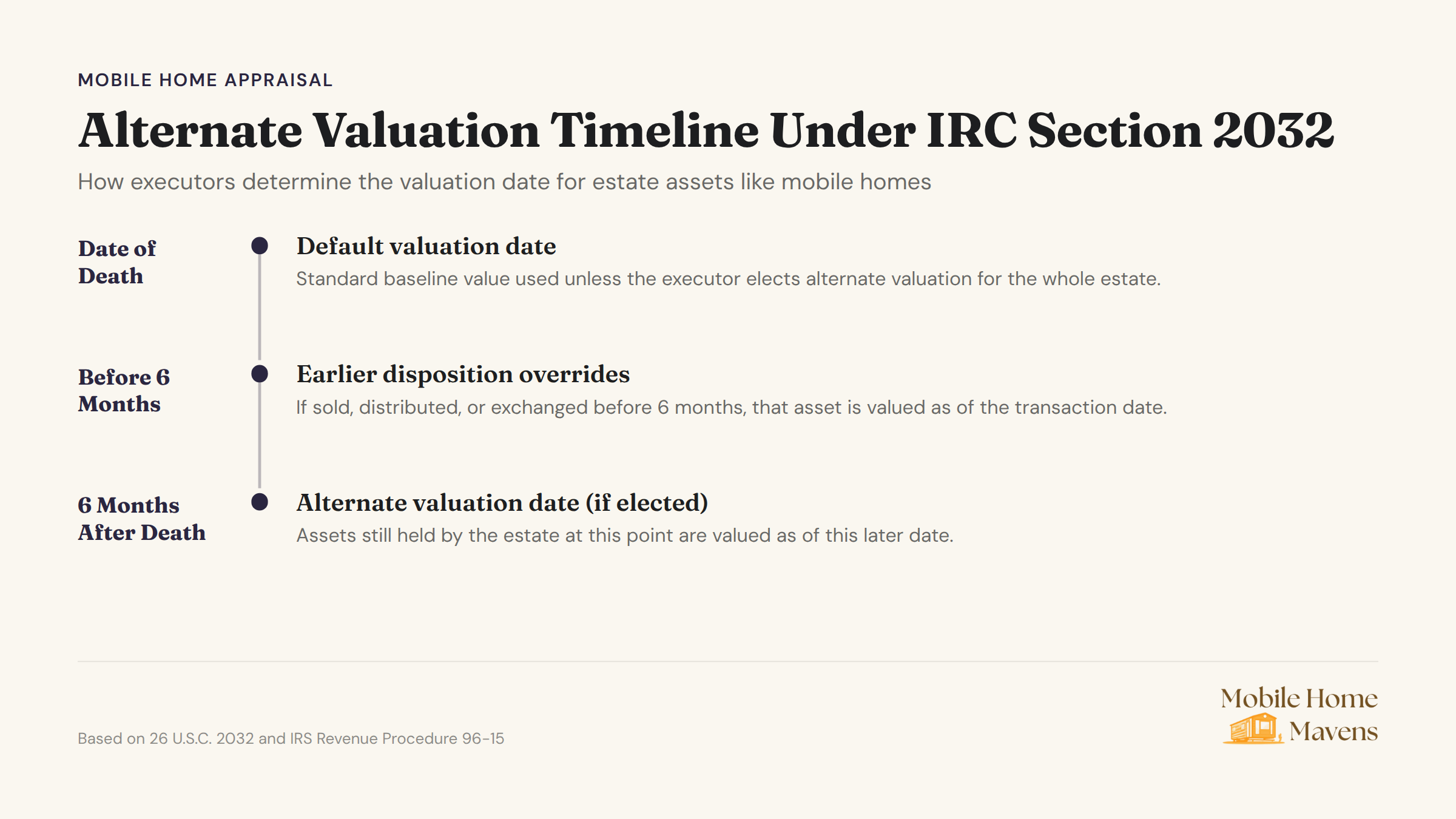
Executors aren't locked into the date-of-death value in every case. Under 26 U.S.C. 2032, an executor can elect to value the entire estate six months after death instead, provided the election reduces both the gross estate's value and the resulting estate tax liability. It's an all-or-nothing election for the estate as a whole; an executor can't cherry-pick the alternate date for just the mobile home while using the date of death for everything else.
IRS guidance on alternate valuation lays out how the six-month rule applies to assets that change hands during that window. Property still held by the estate six months after death is valued as of that later date. Property sold, distributed, or otherwise disposed of before the six months are up is instead valued as of the date of that transaction (IRS Revenue Procedure 96-15).
Example: An executor sells a mobile home to a third party four months after the owner's death because the estate needs cash to pay debts. If alternate valuation is properly elected, the appraisal needs to reflect the value as of that sale date, not the date of death six months earlier.
How a Defensible Appraisal Protects Against Heir Disputes
Mobile homes often sit at the center of family disagreements during probate, partly because they're easy to have strong opinions about and partly because everyone remembers what the park lot used to look like. When an estate splits among multiple heirs, an independently sourced date-of-death value gives the personal representative something to point to that isn't their own word.
Without a third-party appraisal, it's easy for one heir to argue the number was set too high to favor a sibling who's keeping the home, or too low to shortchange someone being bought out of their share. A documented appraisal, dated to the decedent's death and supported by comparable sales, removes the executor's personal judgment from that argument. It also becomes part of the accounting the personal representative typically owes to the probate court and to beneficiaries, giving everyone a neutral figure rather than a disputed one.
Personal Property vs. Real Estate: Why Titling Decides Who Appraises the Home
The single biggest mistake executors make is assuming a mobile home is valued the way a house is. It isn't, and the deciding factor isn't how the home looks sitting on its lot. It's how the home is titled and who owns the land underneath it.
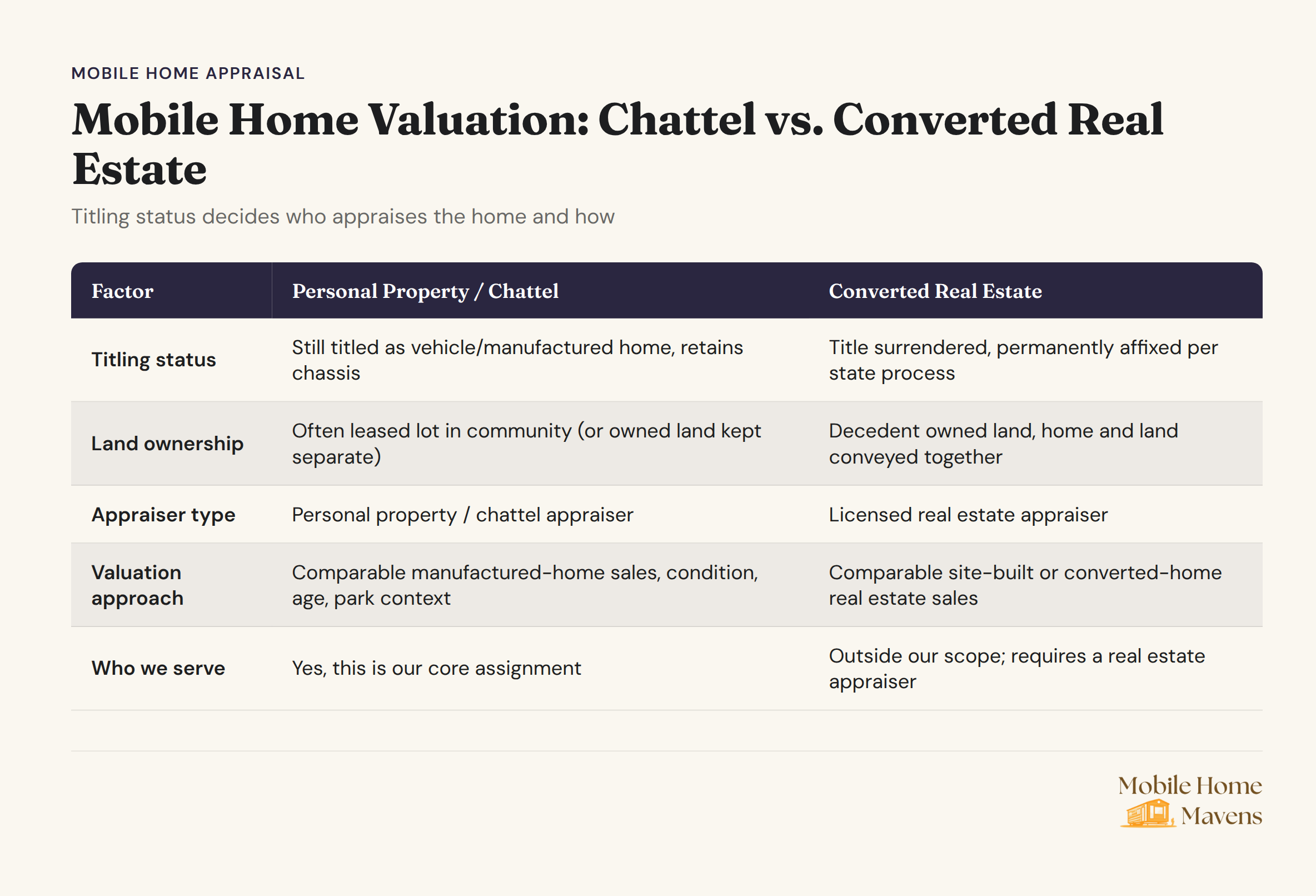
If the home is still titled as personal property, meaning it hasn't been permanently affixed to a foundation and retains its chassis, and it sits on leased or rented land in a manufactured home community, it gets valued as chattel: a personal property asset, separate from any interest in the land. That valuation relies on comparable sales of similar manufactured homes and manufactured-housing-specific market data, the same category of analysis our appraisers perform for mobile home appraisals tied to estate tax filings.
If the home has instead been legally converted to real property (permanently affixed to a foundation, with its title surrendered under the applicable state process) and the decedent owned the land it sits on, the home and land are valued together as real estate. That calls for a licensed real estate appraiser, not a personal property specialist. Our team handles the first scenario: a manufactured or mobile home still titled as personal property, whether it sits on leased land or land the decedent owned outright. For a closer look at how titling status gets determined in the first place, see our guide on whether a mobile home counts as personal property or real estate.
| Factor | Personal Property / Chattel | Converted Real Estate |
|---|---|---|
| Titling status | Still titled as a vehicle/manufactured home, retains chassis | Title surrendered, permanently affixed per state process |
| Land ownership | Often leased lot in a manufactured home community (or owned land kept separate) | Decedent owned the land, home and land conveyed together |
| Appraiser type | Personal property / chattel appraiser | Licensed real estate appraiser |
| Valuation approach | Comparable manufactured-home sales, condition, age, park context | Comparable site-built or converted-home real estate sales |
| Who we serve | Yes, this is our core assignment | Outside our scope; requires a real estate appraiser |
What the Appraisal Report Needs to Document
An appraisal prepared for estate use has to be built to survive scrutiny from the IRS, the probate court, or a skeptical co-heir. At minimum, a report an executor can rely on should include:
- Effective date set to the date of death, not the inspection date, with a clear explanation if the inspection happened later (a common situation when an executor doesn't retain an appraiser until weeks or months into the estate process).
- HUD label or serial number and VIN, which positively identify the specific unit and distinguish it from similar models.
- Year, make, and model, along with square footage, configuration, and any additions or modifications made after manufacture.
- Condition at or near the date of death, including deferred maintenance, upgrades, and any damage that would have affected a buyer's offer on that date.
- Park or lot context, including lot rent, community rules, and location, when the home sits on leased land, since those factors materially affect what a manufactured home is worth independent of the home itself.
Tangible personal property valuation under federal estate tax regulations generally calls for this kind of item-specific documentation rather than a rough estimate (26 C.F.R. 20.2031-6), and that standard applies just as much to a manufactured home as it does to furniture or jewelry inside it.
Getting the Number Right the First Time
An executor only gets one shot at setting the date-of-death value cleanly. Revisiting it later, after the IRS has questioned a Form 706 filing or after heirs have already divided the estate, is far more difficult and expensive than getting an independent appraisal at the outset. Engagements for this kind of report are quoted as a fixed fee once the scope is established, covering the complexity of the title and land situation, the records available, and whether the report needs to meet IRS-qualified standards for an estate tax filing.
Our appraisers prepare these reports in accordance with the Uniform Standards of Professional Appraisal Practice, and hold credentials with organizations such as the ASA, ISA, and AAA. If you're serving as executor or advising one, general guidance on executor and estate requirements can help frame what documentation the file should contain before the appraisal even begins.
This article is provided for general informational purposes only and does not constitute legal, tax, or financial advice. Readers should consult a qualified attorney or CPA regarding their specific circumstances.