
Blog
Mobile Home Appraisal vs. Inspection: What's the Difference?
A mobile home appraisal determines market value for lenders and buyers; a mobile home inspection evaluates physical condition and safety. This guide explains exactly what each covers, who orders it, what it costs, and when you need one or both.
Buying or financing a manufactured home means navigating two separate professional services that are easy to confuse. A mobile home appraisal answers the question "what is this home worth?" A mobile home inspection answers the question "what is wrong with this home?" Both matter, but they serve different purposes, involve different professionals, and have different consequences if you skip them.
What is a Mobile Home Appraisal?
A mobile home appraisal is an independent, written opinion of a property's fair market value, prepared by a state-licensed or state-certified appraiser. Every appraisal must comply with the Uniform Standards of Professional Appraisal Practice (USPAP), published by The Appraisal Foundation, which sets the professional and ethical framework for all real estate and personal property appraisers.
The appraiser evaluates a specific set of factors to reach a value conclusion:
Age, size, and floor plan of the home
Overall condition, as observed during the inspection visit
HUD Data Plate and certification label confirming the home was built to the HUD Code
Whether the home is titled as real property or personal property (this affects which loan programs apply and how comparables are selected)
Recent sales of comparable manufactured homes in the local market
Site characteristics, including whether land is included in the transaction
The appraiser's report delivers a single dollar figure. That number is what the lender uses to confirm the loan amount is supported by the collateral. Our fixed fee for a USPAP-compliant mobile home appraisal is $595, regardless of the purpose, whether that is a purchase, estate settlement, insurance, bankruptcy, or refinance.
What is a Mobile Home Inspection?
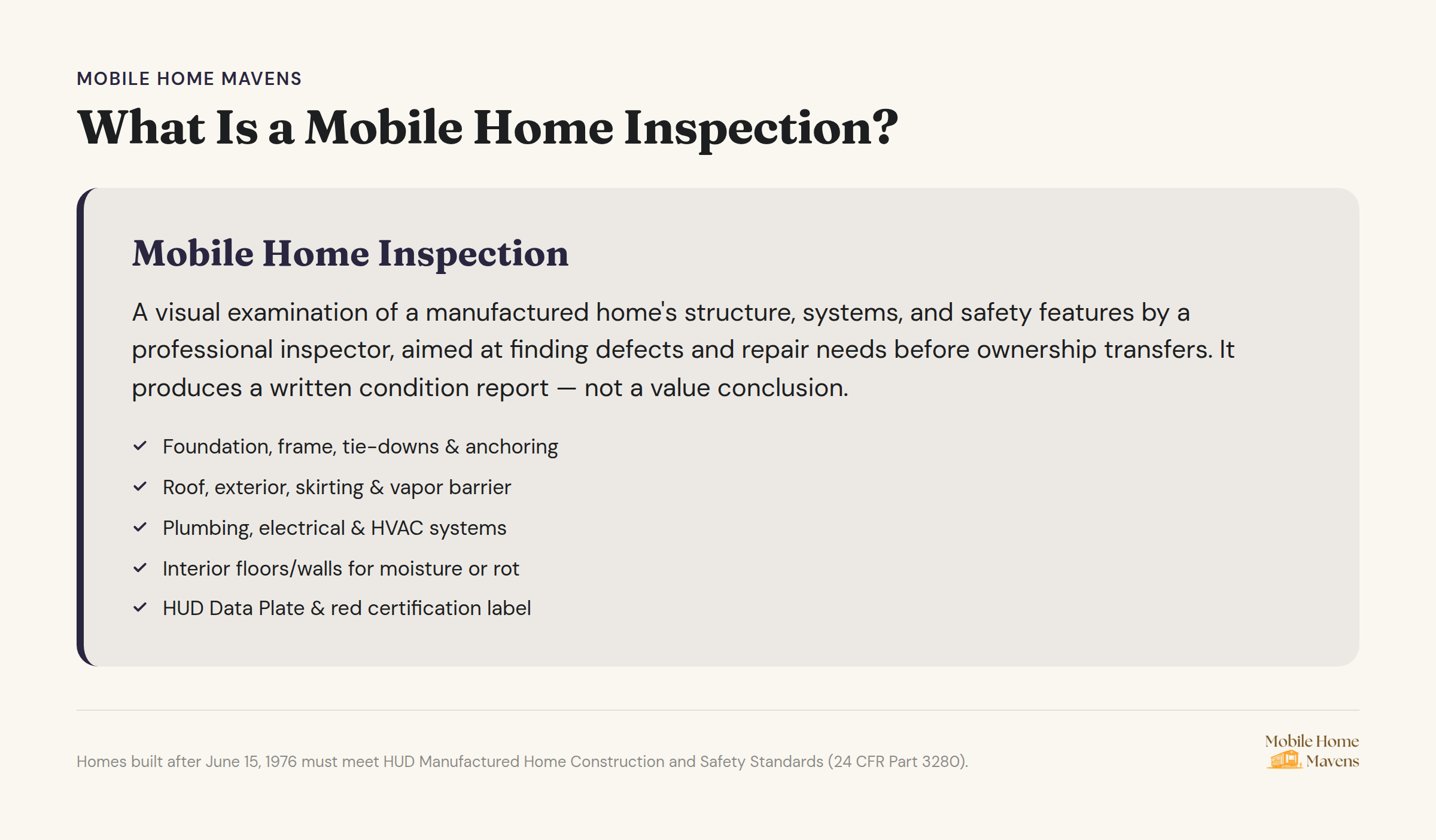
A mobile home inspection is a visual examination of the home's physical structure, systems, and safety features, conducted by a professional home inspector. The goal is to identify defects, safety concerns, and items that need repair before the buyer takes ownership.
A thorough manufactured home inspection covers the following systems and components:
Foundation, piers, tie-downs, and anchoring systems
Frame and chassis condition
Roof, gutters, and attic space
Exterior walls, skirting, and vapor barrier
Plumbing, water heater, and drainage
Electrical panel, wiring, and outlets
HVAC systems and ductwork
Interior ceilings, walls, floors, and subfloor for moisture or rot
HUD compliance labels: the Data Plate (inside the home) and the red HUD certification label (affixed to the exterior)
All manufactured homes built after June 15, 1976 must be constructed to the HUD Manufactured Home Construction and Safety Standards (24 CFR Part 3280), commonly called the HUD Code. The HUD manufactured housing resources page outlines these requirements. The HUD labels confirm a given home was built to that standard. An inspector who finds missing or obscured labels will flag that as a significant issue.
The inspection produces a written condition report with findings, photos, and recommendations. It does not include a value conclusion.
Who Orders Each, and Who Pays?
In a financed transaction, the lender orders the appraisal, and the buyer pays for it as part of the loan closing costs. The appraiser's client is technically the lender, not the buyer, though the buyer receives a copy.
The buyer orders the inspection independently and pays out of pocket. No lender requires it, but buyers who skip it take on real risk.
In a cash purchase, neither service is legally mandatory. That said, skipping both is rarely wise. An appraisal confirms you are paying a fair price; an inspection confirms the home is worth paying for at all.
Appraisal vs. Inspection: Side-by-Side Comparison
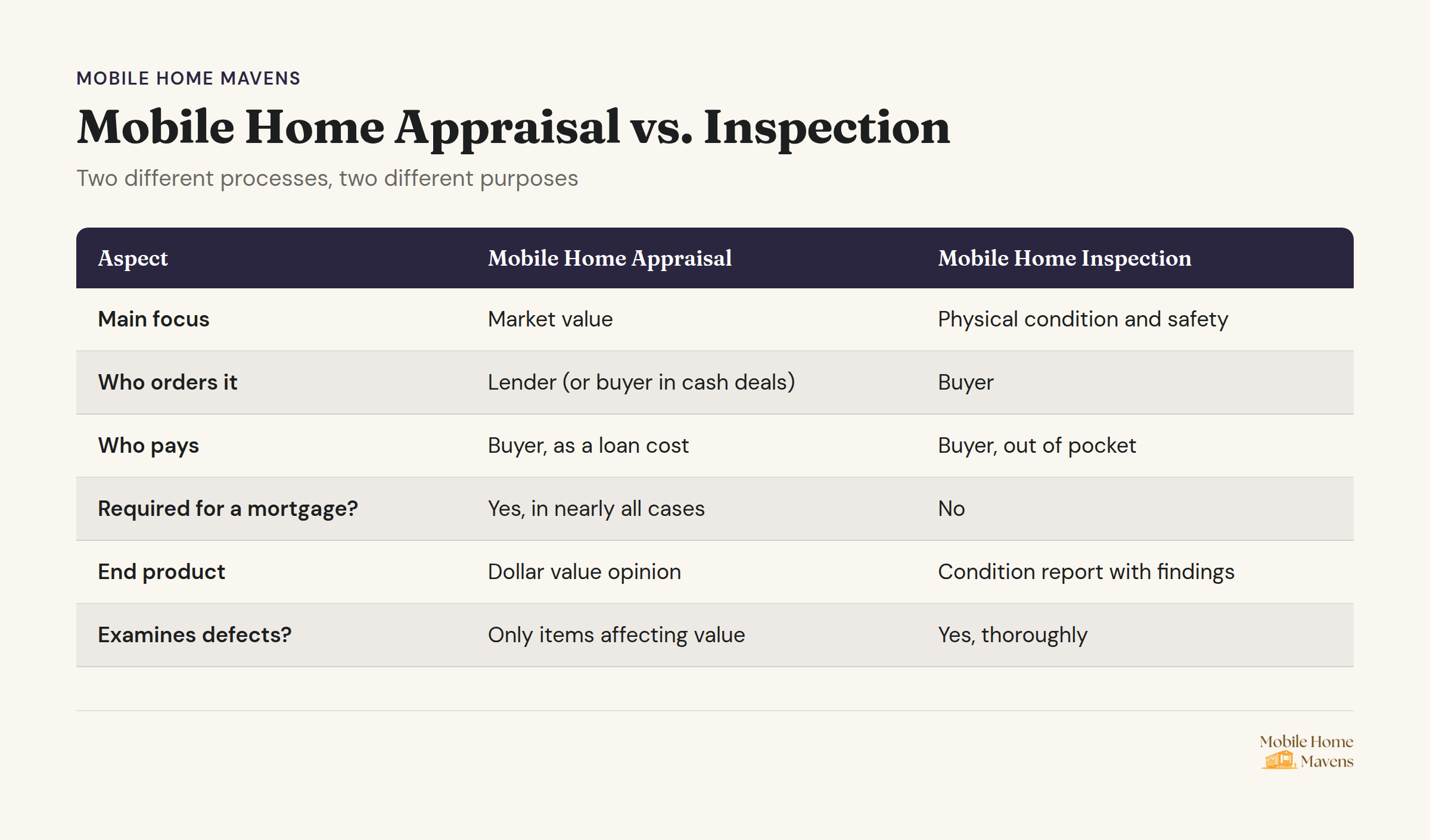
The table below summarizes the key differences between a manufactured home inspection vs appraisal at a glance:
| Aspect | Mobile Home Appraisal | Mobile Home Inspection |
|---|---|---|
| Main focus | Market value | Physical condition and safety |
| Who orders it | Lender (or buyer in cash deals) | Buyer |
| Who pays | Buyer (as a loan cost) | Buyer (out of pocket) |
| Required for a mortgage? | Yes, in nearly all cases | No |
| End product | Dollar value opinion | Condition report with findings |
| Examines defects? | Only items affecting value | Yes, thoroughly |
When Do You Need Both?
Whether you need one or both services depends on your transaction type:
Financed purchase: The lender requires an appraisal. Inspection is optional, but strongly recommended. FHA, VA, and USDA loans will also require a HUD-compliant foundation engineering certification if the home is to be classified as real property.
Cash purchase: Neither is mandatory. An appraisal confirms fair pricing; an inspection protects you from buying a home with serious hidden problems.
Older homes and relocated homes: Both are highly advisable. Manufactured homes that have been moved even once are significantly more prone to frame damage, subfloor rot, water intrusion, and broken seals. An appraiser notes the obvious condition items, but a thorough inspection digs into the details that an appraisal was never designed to find.
Watch out: The appraisal is not a home inspection. Appraisers observe condition only to the extent it affects market value. They are not scanning for every defect or verifying systems function correctly. If you want to know whether the plumbing leaks, the subfloor is solid, or the roof has two years left, you need an inspector. That is not a knock on appraisers; it is simply not what the appraisal is for.
Get a USPAP-Compliant Mobile Home Appraisal in Days
Our team delivers USPAP-compliant mobile home appraisal reports at a fixed fee of $595, with no hidden costs based on purpose or loan type. Whether you need a value for a purchase, refinance, estate, or insurance claim, we cover it under one straightforward fee. Request your appraisal today and we will be in touch promptly.
This article is provided for general informational purposes only and does not constitute legal, tax, or financial advice. Readers should consult a qualified attorney or CPA regarding their specific circumstances.