
Blog
How Courts Use Mobile Home Appraisals in Divorce Property Division
A mobile home appraisal in divorce gives the court an independent, defensible value it can rely on instead of either spouse's estimate, but how that value gets used depends on whether the home is titled as chattel or classified as real estate. This guide covers the classification rules, leased-land complications, and valuation-date questions that shape property division cases.
When a marriage ends and a mobile or manufactured home is part of the estate, the value of that home rarely settles itself. One spouse thinks it's worth more because of the kitchen remodel they paid for. The other thinks it's worth less because they're the one who has to sell it. Courts resolve that gap with a mobile home appraisal divorce proceedings can rely on: an independent, third-party valuation that isn't tied to either party's financial interest in the outcome.
Our team prepares these reports for attorneys, mediators, and individuals working through mobile home appraisal for divorce matters in courts across the country. This article walks through how judges actually use that appraisal once it lands on their desk: how the home gets classified, how leased land changes the math, and who decides the date the appraisal has to reflect.
Why Courts Require an Independent Valuation, Not a Spouse's Estimate
Courts need a neutral number because both spouses have a financial incentive to distort the value. The spouse keeping the home benefits from a lower appraisal; the spouse being bought out benefits from a higher one. An independent appraiser has no stake in either outcome, which is exactly why judges and attorneys treat a third-party report as credible evidence rather than a starting point for negotiation.
That independence matters more with mobile and manufactured homes than with most other marital assets, because the value can swing widely based on age, installation quality, and whether the unit meets federal construction standards. A report built on recognized methodology gives the court something it can actually weigh, rather than two competing guesses.
Key takeaway: the appraisal's value in a divorce case comes from its neutrality and its methodology, not from either spouse agreeing with the number.
Chattel vs. Real Property: Why Classification Determines Who Values the Home
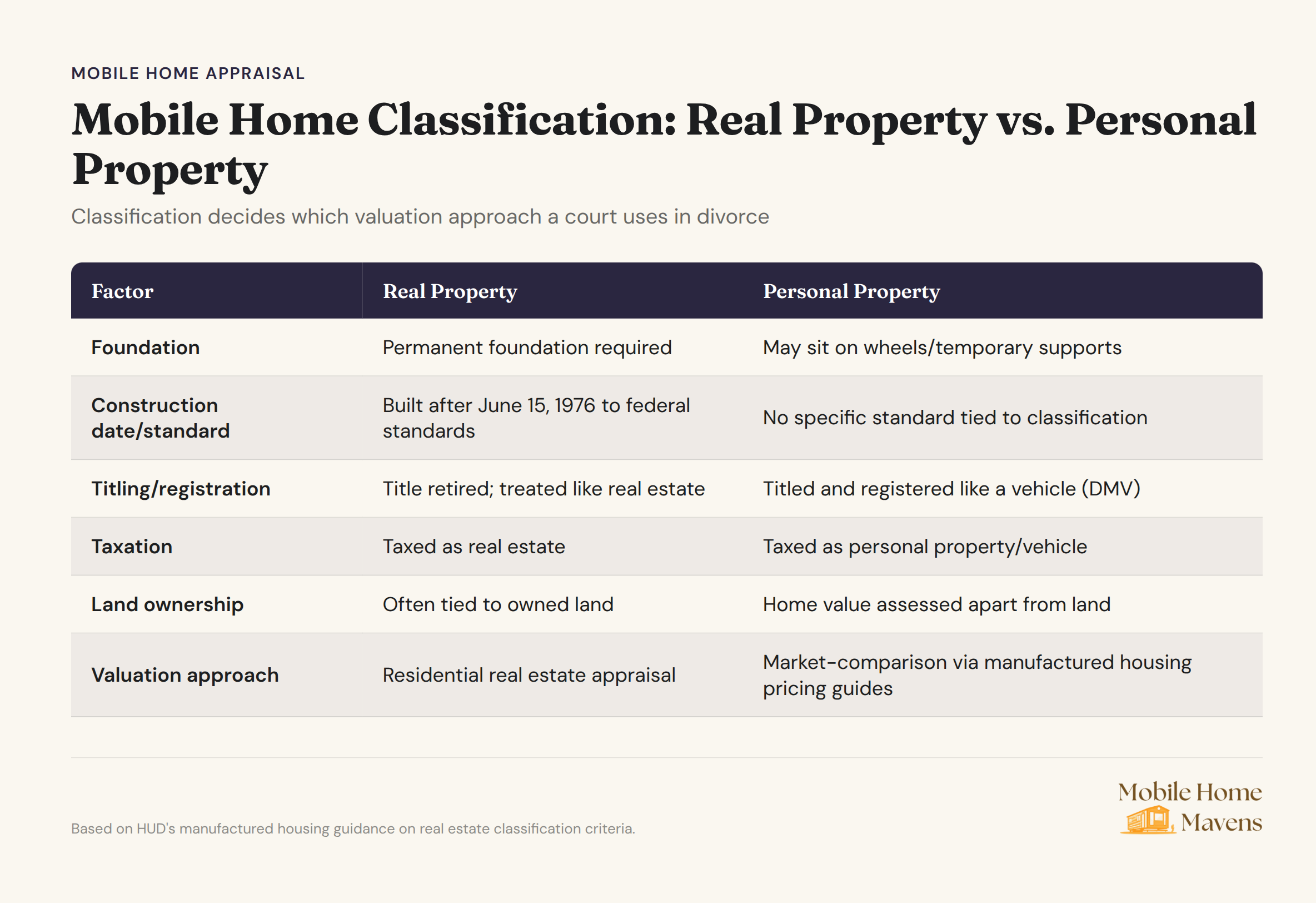
The single biggest question in a mobile home divorce case is whether the home counts as real property (part of the real estate) or personal property (a titled chattel, similar to a vehicle). That classification changes which valuation approach applies and, in many cases, which appraiser credentials are appropriate for the job.
Federal housing guidance lays out the conditions a manufactured home generally has to meet to be treated as real estate rather than personal property, including a minimum floor area, construction after June 15, 1976 to federal manufactured housing construction standards, placement on a permanent foundation, and classification and taxation as real estate rather than as a vehicle, per HUD's manufactured housing guidance. When a home is titled and taxed as personal property instead, valuation typically follows a market-comparison approach built around published manufactured housing pricing guides rather than a residential real estate appraisal.
Our guide on personal property versus real property classification covers this distinction in more depth, since it also affects insurance, financing, and title transfer, not just divorce proceedings.
Leased Land Complicates the Math: Dividing the Home Without the Ground Under It
Many mobile homes sit in a leased-lot community, where one or both spouses own the structure outright but hold only a lease, not a deed, to the land beneath it. This is a common setup, and it forces the court to separate two distinct assets that would otherwise be valued together.
In a leased-land situation, the appraisal typically values the home itself as if it could be relocated or sold in place, while the leasehold interest (the remaining value of the lot lease, if it has any transferable value at all) gets evaluated separately, often by the attorneys rather than the appraiser. The practical effect: a spouse awarded the home in a leased-land park may also be inheriting ongoing lot rent obligations that a spouse on owned land would not have, which can factor into how the court balances the rest of the division.
Example: A couple divorcing owns a manufactured home worth $58,000 outright but leases the lot for $650 a month with no ownership interest in the land. The appraisal establishes the $58,000 figure for the home; the court and attorneys separately weigh the ongoing lease obligation when deciding who keeps the unit and what offset, if any, is fair.
Watch out: a title search or park lease agreement, not the appraisal itself, is usually what confirms whether land is owned or leased. An appraiser working from an incomplete file may need that documentation before the report can be finalized.
Community Property vs. Equitable Distribution: Two Starting Points, One Appraisal
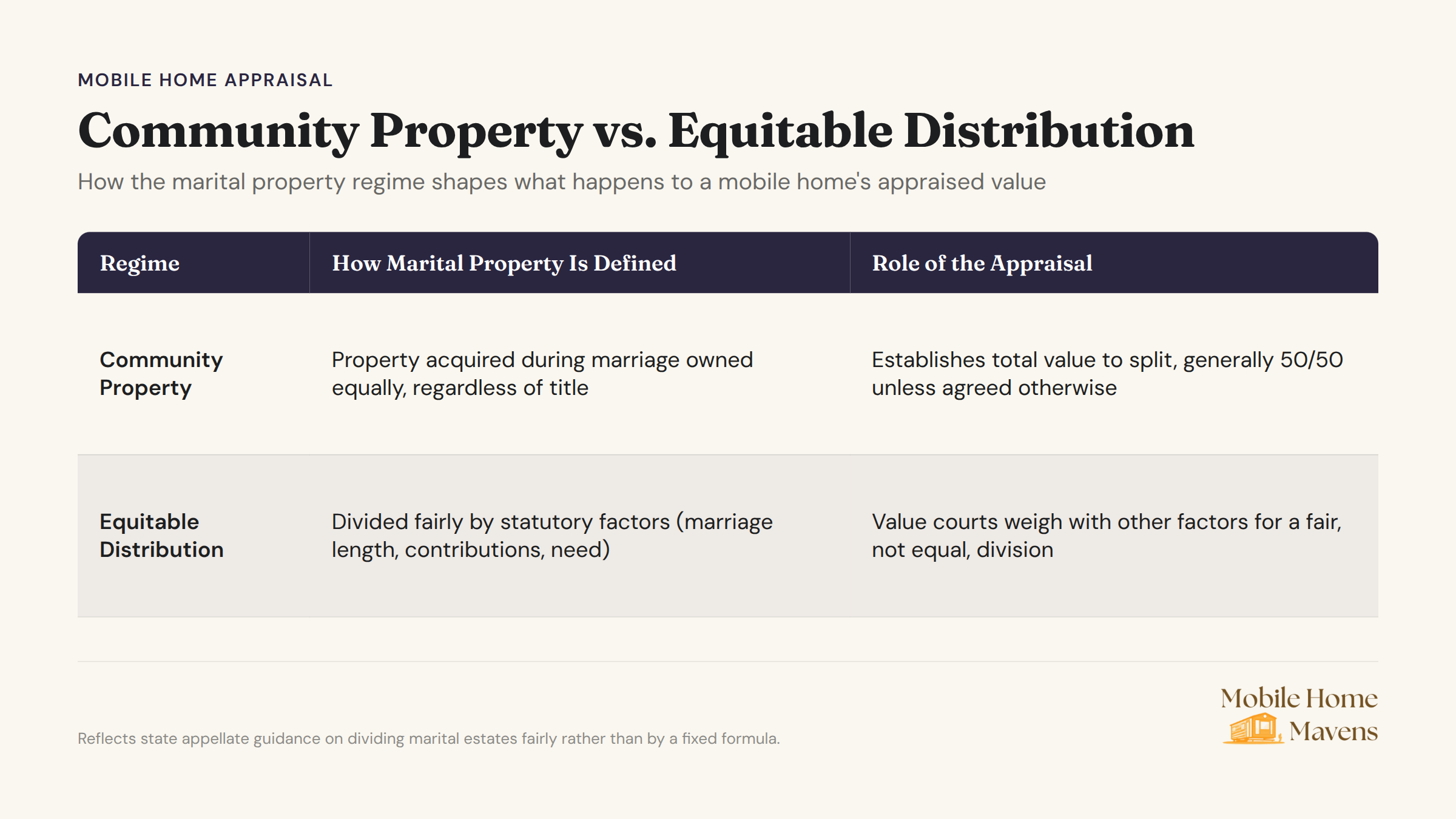
How a mobile home's appraised value gets divided depends heavily on the marital property regime the state follows. Community property states generally treat property acquired during the marriage as owned equally by both spouses, while equitable distribution states direct courts to divide marital property fairly, though not necessarily equally, after weighing a list of statutory factors.
Equitable distribution frameworks commonly direct courts to consider the value of property at the relevant time, whether it was acquired before or during the marriage, and each spouse's financial circumstances, income-producing capacity, and contributions, a structure reflected in state appellate guidance on dividing marital estates fairly rather than by a fixed formula. The appraisal supplies the value; the statute supplies the rule for what happens to that value.
| Regime | How marital property is defined | Role of the appraisal |
|---|---|---|
| Community property | Property acquired during marriage is owned equally by both spouses, regardless of whose name is on the title | Establishes the total value to be split, generally 50/50 absent an agreement otherwise |
| Equitable distribution | Marital property is divided fairly based on statutory factors (length of marriage, contributions, need, etc.), not necessarily equally | Establishes the value courts weigh alongside other factors to reach a fair, not equal, division |
Neither regime asks the appraiser to decide who gets the home or in what proportion. That determination belongs to the court, the settlement agreement, or the mediator, not the valuation report.
Who Sets the Valuation Date, and Why It Isn't the Appraiser's Call
The effective date of value in a divorce appraisal is set by the jurisdiction's rules or by the attorneys handling the case, not by the appraiser. Depending on the state, that date might be the date of separation, the date the divorce petition was filed, or the date of trial, and each can produce a meaningfully different number if the market or the home's condition changed in between.
Appraisers are equipped to value a mobile home as of any specified date, including a date months or years in the past, by working from historical market data and condition records rather than a current-day inspection alone. What they cannot do, and shouldn't be asked to do, is choose which date applies. That decision comes from the governing statute or from instructions given by the client's attorney.
Pro tip: confirm the required valuation date with your attorney before the appraisal is scheduled. Reordering an appraisal because the wrong effective date was used adds cost and delay that's entirely avoidable with one conversation up front.
Courts have also had to work out how to treat value changes that happen after the relevant valuation date. In at least one appellate ruling, a court held that appreciation occurring after the date the marital estate is measured is not itself marital property to be divided, but is instead a factor the court may still weigh in deciding how to divide what came before it, an approach reflected in published appellate reasoning on post-separation asset appreciation (case discussion via CaseMine). The appraisal, again, supplies the numbers; the court applies the doctrine.
When Marital Funds Pull a Separate-Property Home Into the Marital Estate
A mobile home owned by one spouse before the marriage, or received as a gift or inheritance, generally starts out as separate property. But that status isn't necessarily permanent. If marital funds went toward a new roof, a foundation upgrade, loan payments, or other improvements during the marriage, courts in many jurisdictions will treat some portion of the home's value as having become marital property through that contribution.
This is one of the more contested issues in mobile home divorce cases, because it requires tracing which dollars paid for what and when. An appraisal that documents the home's condition and improvements, paired with financial records showing the source of the funds used, gives the attorneys what they need to argue how much of the value should be treated as marital versus separate.
Example: A spouse owned a manufactured home worth $40,000 before marriage. During the marriage, the couple spent $15,000 in joint funds on a new HVAC system, siding, and a permanent foundation. The appraisal today values the home at $62,000. Attorneys and the court then have to work out how much of that $22,000 increase reflects the marital investment versus ordinary market appreciation that would have happened regardless.
Our chattel appraisal guide for mobile homes covers how appraisers document improvements and condition changes in more detail, which is often the evidence attorneys lean on when making this argument.
Getting the Appraisal Right the First Time
A mobile home appraisal in divorce only does its job if it holds up to scrutiny from both sides and, if necessary, from the court itself. That means using recognized methodology, USPAP-consistent reporting practices, and documentation thorough enough to withstand a challenge from opposing counsel. Credentialing bodies including the ASA, ISA, and AAA maintain the standards that personal property appraisers are trained against, and a report built to that standard travels well through negotiation, mediation, and litigation alike.
If you're facing a property division that includes a mobile or manufactured home, get the classification question and the valuation date settled with your attorney before scheduling the appraisal. Getting those two details right up front is what keeps the report useful instead of contested.
This article is provided for general informational purposes only and does not constitute legal, tax, or financial advice. Readers should consult a qualified attorney regarding their specific circumstances.