
Blog
How a Mobile Home Appraisal for FEMA Claim Strengthens Your Disaster Recovery Case
A mobile home appraisal for FEMA claim documents pre-disaster fair market value and post-damage replacement cost, giving your recovery case independent evidence beyond a FEMA inspection or contractor estimate. Here's what the report needs to include and how the process actually works.
When a flood, hurricane, tornado, or fire destroys or damages a manufactured home, the paperwork that proved what the home was worth before the disaster is often gone along with the home itself. That's the moment a professional mobile home appraisal earns its keep. It doesn't replace FEMA's inspection or an SBA loan officer's underwriting, but it gives you an independent, USPAP-compliant record of value that can carry real weight in an appeal, a disputed insurance claim, or a courtroom.
What FEMA and SBA Disaster Programs Actually Require
FEMA Individual Assistance and SBA disaster loans are built around a FEMA home inspection and, for SBA borrowers, contractor repair or replacement estimates. Neither program mandates a formal third-party appraisal to receive an initial award. That's an important distinction, and homeowners should go in with accurate expectations rather than assuming an appraisal is a checkbox requirement.
Where an appraisal becomes valuable is at the margins: when a claim is denied, underpaid, or disputed, and the homeowner needs something more substantial than a contractor's estimate to make the case. FEMA's own flood-claim appeal rules illustrate this directly. Under 44 CFR 62.20, a policyholder appealing a flood claim decision has 60 days to file, and the regulation specifically lists a real estate appraisal that excludes land value, along with a completed Mobile Home Worksheet, among the documentation FEMA may require to adjudicate that appeal. In other words, FEMA doesn't demand an appraisal up front, but it recognizes one as legitimate, useful evidence once a dispute exists.
Key takeaway: A mobile home appraisal isn't a mandatory step in filing with FEMA or SBA. It's the tool that strengthens an appeal, a disputed claim, or a total-loss determination when the initial award doesn't match the homeowner's own documentation of value.
Why Documented Value Matters After a Flood, Hurricane, Tornado, or Fire
Here's the practical problem every disaster survivor runs into: the records that would normally prove pre-loss condition and value (photos, receipts, prior listings, even the home itself) are frequently destroyed alongside the property. A home that burned in a wildfire or was swept off its foundation in a flood can't be inspected in its pre-loss state. Adjusters, FEMA reviewers, and SBA loan officers are left reconstructing value from whatever secondhand evidence survives.
A professional appraisal fills that gap by establishing an effective date of value tied to the loss event, supported by comparable sales data, manufacturer specifications, tax records, and any surviving photos or documentation. This matters most in a few recurring scenarios:
- Total-loss disputes: When an insurer or FEMA reviewer values the home lower than the homeowner believes is accurate, a documented pre-disaster fair market value gives the appeal something concrete to argue from.
- Partial damage claims: When the home is repairable but the cost estimate is contested, a post-damage replacement cost or repair-based diminution analysis can clarify what full restoration actually requires.
- Missing pre-loss records: When tax assessments, prior sales, or purchase documentation were lost with the home, an appraiser can reconstruct value using market data, manufacturer records, and comparable manufactured home sales in the area.
Watch out: Waiting too long after a disaster to commission an appraisal makes the pre-loss reconstruction harder, since debris removal, further weather damage, and site changes can erase evidence an appraiser would otherwise document. Earlier engagement generally produces a stronger report.
What a USPAP-Compliant Mobile Home Appraisal Report Must Include
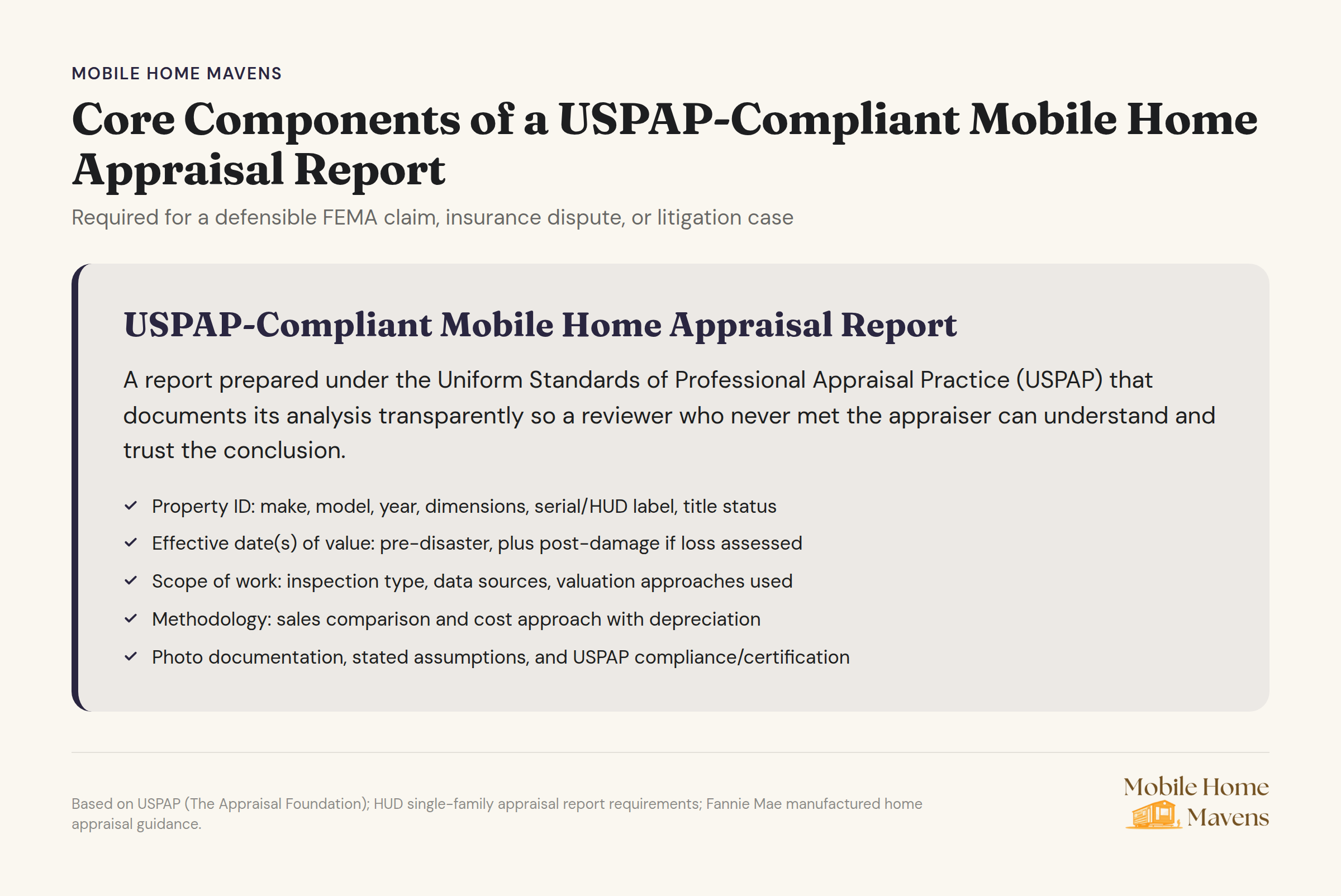
A report intended to support a FEMA appeal, an insurance dispute, or litigation needs to do more than state a number. It needs to show its work in a way that's transparent and defensible to a reviewer who has never met the appraiser. Our appraisers prepare every report in accordance with the Uniform Standards of Professional Appraisal Practice (USPAP), published by The Appraisal Foundation, which requires the report to be sufficiently detailed for its intended users to understand the analysis without being misleading.
At minimum, a defensible mobile home appraisal report for this purpose should include:
- Identification of the property: make, model, year, dimensions, serial or HUD label number, and title status of the manufactured home.
- Effective date of value: typically the date immediately before the casualty event for a pre-disaster value opinion, with a separate post-damage date if the assignment also covers loss or diminished value.
- Scope of work: a clear statement of whether the appraiser performed an interior and exterior inspection, what data sources were reviewed, and which valuation approaches were applied.
- Methodology: sales comparison analysis using comparable manufactured home sales, and where relevant, a cost approach that accounts for depreciation, physical deterioration, and functional or external obsolescence.
- Photo documentation: clear images of the subject property and, where damage is part of the assignment, photos showing the extent and nature of that damage.
- Extraordinary assumptions or hypothetical conditions: stated clearly if the value opinion depends on the home being valued "as completed" following repairs, or on assumptions about pre-loss condition where records are incomplete.
- USPAP compliance statement and appraiser qualifications: a certification section naming the appraiser and disclosing any significant assistance from other individuals in preparing the report.
Government appraisal-data guidance for manufactured housing gives a useful sense of the level of detail expected: reports covering FEMA flood zone data, a description of physical deterioration or functional and external depreciation, and gross living area calculations based on width times length, with any adjustments explained rather than asserted. See HUD's single-family appraisal report requirements and Fannie Mae's manufactured home appraisal guidance for the kind of documentation depth that reviewers expect from a credible report, even though these specific guides govern mortgage lending rather than disaster claims. USPAP itself does not dictate a required form or template; it requires the appraiser, not a form, to comply with its ethics and performance standards, as detailed in USPAP's reporting and record-keeping standards.
We should be direct about one thing: preparing a report in accordance with USPAP is not the same as guaranteeing FEMA, an insurer, or a lender will accept the concluded value. A well-documented, standards-compliant report gives a reviewer defensible evidence to weigh. The reviewing body still makes its own determination.
How the Appraisal Process Works: Online vs On-Site Inspection
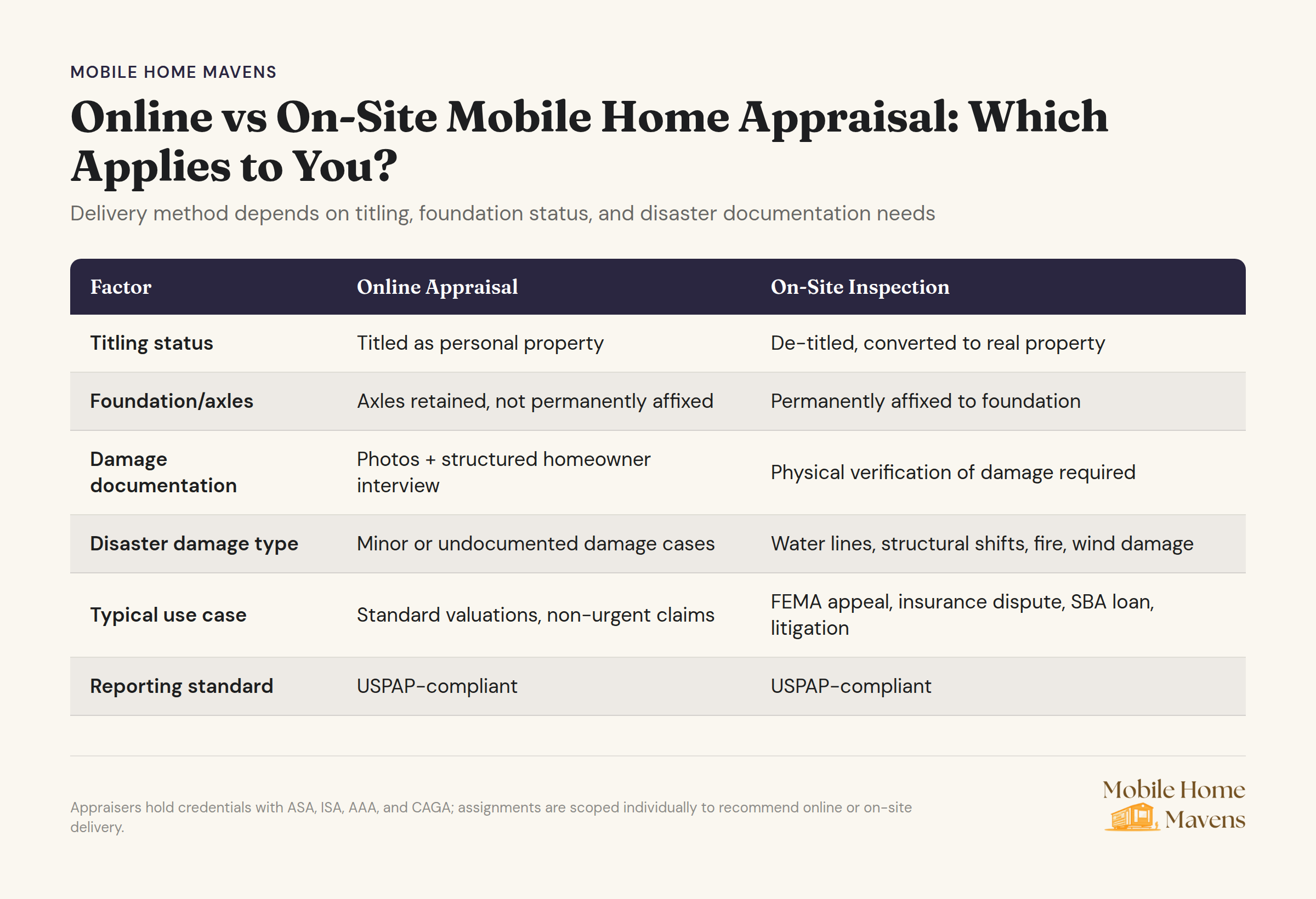
Whether a mobile home appraisal can be completed online or requires an on-site visit depends largely on how the home is titled and situated. A manufactured home that still carries its title as personal property, retains its axles, and isn't permanently affixed to a foundation can often be appraised through an online process using photos, documentation, and a structured homeowner interview. A home that has been de-titled and converted to real property, or one where the assignment specifically requires physical verification of damage, typically needs an on-site inspection.
For disaster-related work specifically, an on-site inspection is frequently the better choice, since photo documentation of the damage itself (water lines, structural shifts, fire damage, wind damage to the roof or skirting) is central to the report's credibility. Our appraisers scope each assignment individually and will recommend online or on-site delivery based on the home's classification, the extent of the damage, and what the intended use (FEMA appeal, insurance dispute, SBA loan file, litigation) requires.
Before the appraisal begins, homeowners can speed up the process by gathering:
- Title documentation: the manufactured home's title or, if converted, the real property deed showing how the home is classified.
- Pre-loss records: purchase documents, prior tax assessments, insurance declarations pages, and any photos of the home before the disaster.
- Post-loss documentation: photos of the current damage, the FEMA inspection report if one has been completed, and any contractor repair or replacement estimates already obtained.
- Insurance and claim correspondence: the claim number, adjuster contact information, and any denial or underpayment letters if the appraisal is being prepared to support an appeal.
Our appraisers hold credentials with organizations including the ASA, ISA, AAA, and CAGA, and every mobile home appraisal report is prepared in accordance with USPAP regardless of whether it's delivered online or through an on-site inspection. If you're unsure whether your situation calls for a mobile home appraisal for a bonded title or a standard disaster-related valuation, our team can help scope the right assignment before work begins.
Who Else This Report Supports: Insurance Claims, SBA Loans, and Litigation
A well-prepared mobile home appraisal rarely serves just one purpose. The same documented, USPAP-compliant record of pre-disaster value and post-damage condition can support several parallel processes that often run at the same time after a disaster.
- Insurance claims: FEMA's own flood-claim appeal materials specifically contemplate appraisals, photos, inventories, and a mobile home worksheet as supporting documentation, which signals how insurers and claim reviewers generally view independent appraisal evidence.
- SBA disaster loans: SBA disaster lending decisions typically turn on proof of ownership, documented damage, and the amount needed to repair or replace the home. A pre-loss and post-loss appraisal helps substantiate the collateral value and the economics of repair versus replacement, alongside whatever loan-specific documentation the SBA program requires.
- Litigation and disputes: When a denied or underpaid claim ends up in a dispute or legal proceeding, a USPAP-compliant report gives an attorney, mediator, or court a clearly reasoned, independently prepared opinion of value, one that states its methodology and assumptions in a form suitable for expert review rather than relying solely on a contractor's repair estimate.
One practical distinction worth remembering: a FEMA appraisal prepared to satisfy flood-claim appeal documentation should generally isolate the value of the home itself from the value of the land underneath it, since FEMA's mobile home dwelling loss documentation is concerned with the structure, not the site. An appraiser experienced in manufactured housing knows to separate those two values cleanly rather than blending them into a single figure that raises questions during review.
Pro tip: If you expect to use the same report across multiple channels (an insurance appeal, an SBA loan file, and possibly litigation down the road), say so when you request the appraisal. Our appraisers can scope the assignment to address each intended use from the start rather than requiring a second engagement later.
Getting Started After a Disaster
After a flood, hurricane, tornado, or fire, the paperwork trail that would normally prove what your manufactured home was worth is often the first thing to disappear. A professional appraisal rebuilds that trail: a documented pre-disaster fair market value, a clear accounting of post-damage condition or replacement cost, and a report built to hold up under review by FEMA, an insurer, an SBA loan officer, or a court.
If you're navigating a disputed FEMA claim, an underpaid insurance settlement, or an SBA disaster loan application, our mobile home appraisal team can scope an assignment built around your specific documentation needs. Request a mobile home appraisal to get started, or review our guide on what a chattel appraisal covers if you're unsure how your home is classified.
This article is provided for general informational purposes only and does not constitute legal, tax, or financial advice. Readers should consult a qualified attorney or their insurance carrier, FEMA, or SBA representative regarding their specific circumstances.