
Blog
FHA Mobile Home Appraisal Requirements: What Buyers and Lenders Need to Know
FHA manufactured home appraisal requirements are stricter than those for site-built homes, and a single missed eligibility condition can kill the loan. This guide covers HUD eligibility standards, foundation certification, what the appraiser inspects, and the most common fail points to address before closing.
A mobile home appraisal for an FHA-insured loan is not the same as a standard residential appraisal. FHA has a specific set of eligibility rules that apply only to manufactured housing, and if the property fails any one of them, the loan cannot close, regardless of value. Buyers and lenders who understand these rules upfront avoid the costly surprise of a failed appraisal after the purchase contract is signed.
Does Your Home Qualify for FHA Financing?
Before an appraiser even sets foot on the property, the home must clear several hard eligibility tests defined in HUD Handbook 4000.1. A home that fails any of these is ineligible for FHA financing, full stop.
FHA's manufactured home eligibility standards require all of the following:
Construction date: The home must have been built on or after June 15, 1976, and must comply with the Federal Manufactured Home Construction and Safety Standards (HUD Code). Homes built before that date are not eligible.
Minimum floor area: The home must have at least 400 square feet of living space. There is no workaround for a home that falls short.
Single-family dwelling: The home must be designed as a one-family unit.
HUD Certification Label: Each transportable section must carry a HUD Certification Label (the "HUD tag"), or the borrower must provide a HUD-issued label verification letter confirming the home's compliance.
Real property classification: The home must be legally classified as real property, not personal property or chattel, under applicable state and local law.
No prior residential installation: FHA generally requires that the home was transported directly from the manufacturer or dealer to its current site. A home that has been previously installed at another residential location typically does not qualify.
If you are unsure whether a home meets these standards, review our FAQ on what makes a mobile home eligible before proceeding with a lender.
The Foundation Certification Requirement
This is the single most common deal-killer in FHA manufactured home transactions. The home must be affixed to a permanent foundation that complies with HUD's Permanent Foundations Guide for Manufactured Housing (PFGMH, publication 4930.3G).
FHA also requires that the home remain on its permanent chassis; the chassis cannot be removed as part of the installation. Beyond that, the lender must obtain a certification from a licensed engineer or architect confirming that the foundation meets PFGMH standards. The appraiser's role is not to issue that certification, but the appraiser must observe and note any visible foundation deficiencies. If the foundation appears non-compliant during the inspection, the appraiser will condition the report on a satisfactory engineer certification before the loan can proceed.
Watch out: Do not wait until the appraisal to discover a foundation problem. If there is any doubt, hire a licensed engineer to assess PFGMH compliance before the appraisal is ordered. Retrofitting a foundation after the appraisal has already flagged it adds cost and delays closing.
What FHA Appraisers Check During the Inspection
FHA appraisers use Form 1004C (Manufactured Home Appraisal Report), which is specific to manufactured housing. A standard residential form is not acceptable. The appraiser must photograph and document both the HUD Certification Labels on each section and the HUD data plate, which is typically located inside the home near the electrical panel or in a kitchen cabinet.
Beyond the labels, the appraiser inspects the following areas to confirm the home meets FHA's Minimum Property Requirements (MPRs):
Exterior and interior condition: Structural soundness, roof, walls, floors, and windows. Obvious safety and habitability issues must be noted.
Utilities and mechanical systems: Heating, plumbing, and electrical must be functional and free of observable deficiencies. A permanent heating system capable of maintaining a livable interior temperature is required.
Grading, drainage, and site access: Water must drain away from the structure; the site must have safe and reasonable vehicular access.
Additions and modifications: Porches, decks, and room additions must appear professionally constructed. Unpermitted or visibly unsafe additions are flagged.
Flood zone status: Homes in FEMA Special Flood Hazard Areas (Zones A or V) face additional documentation requirements and may require flood insurance.
Lead-based paint: For any improvements built before 1978, the appraiser must check for chipping or peeling paint and call for remediation if found.
Comparable sales: The appraisal grid must include at least 2 comparable sales of manufactured homes. When manufactured-home comparables are scarce, the appraiser may supplement with site-built comparables and apply appropriate adjustments, consistent with Fannie Mae's guidance for manufactured housing.
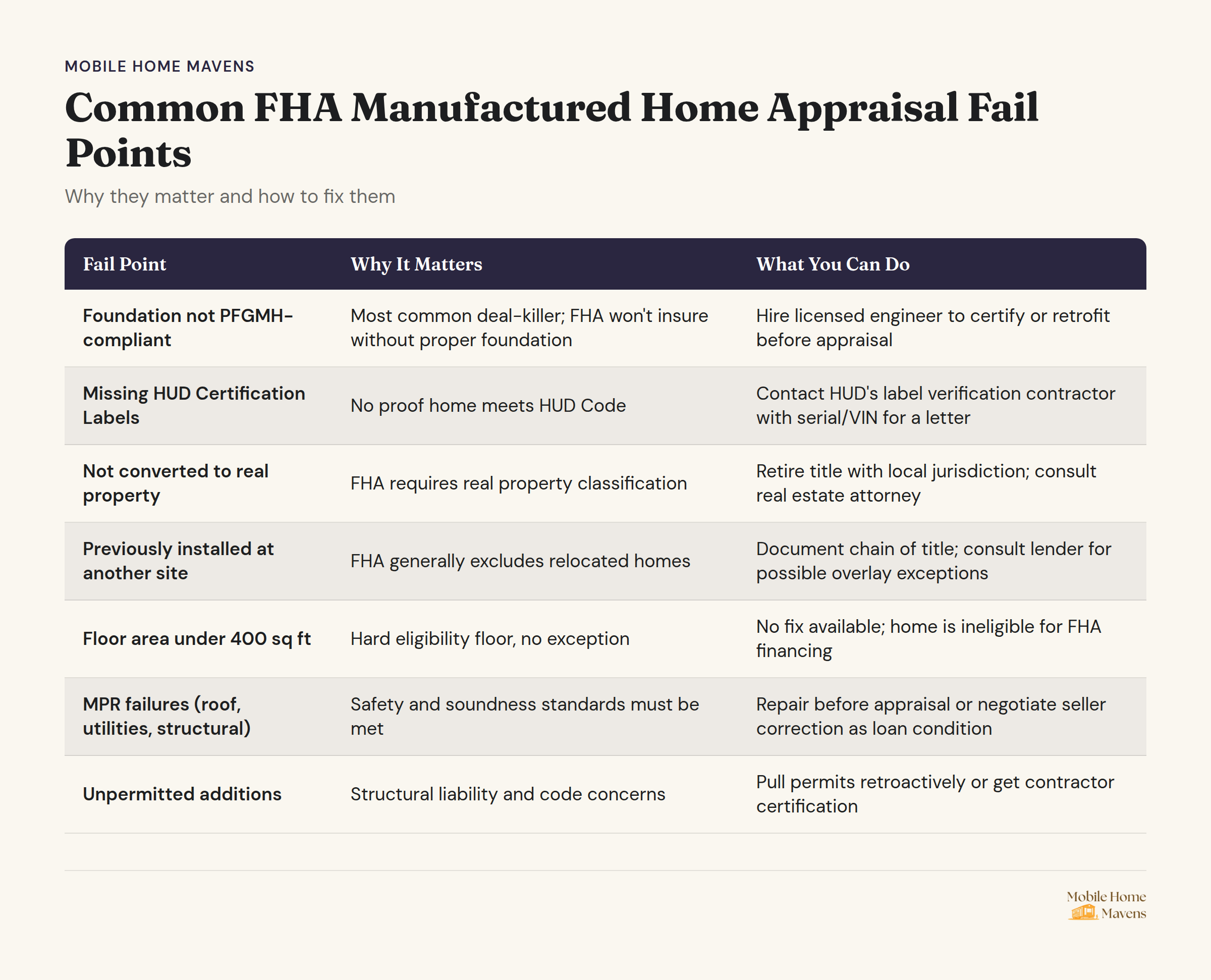
Common FHA Appraisal Fail Points (and How to Fix Them)
The table below covers the issues that most frequently derail FHA manufactured home appraisals, along with practical remedies.
Fail Point | Why It Matters | What You Can Do |
|---|---|---|
Foundation not PFGMH-compliant | Most common deal-killer; FHA will not insure without a proper foundation | Hire a licensed engineer to certify or retrofit before ordering the appraisal |
Missing HUD Certification Labels | No proof the home meets HUD Code | Contact HUD's label verification contractor using the home's serial/VIN number to obtain a letter |
Home not converted to real property | FHA requires real property classification | Work with the local jurisdiction to retire the title and convert; consult a real estate attorney |
Previously installed at another site | FHA generally excludes relocated homes | Document the chain of title and consult your lender; some lender overlays allow exceptions |
Floor area under 400 sq ft | Hard eligibility floor with no exception | No fix available; the home is ineligible for FHA financing |
MPR failures (roof, utilities, structural) | Safety and soundness standards must be met | Repair before the appraisal or negotiate with the seller to correct as a loan condition |
Unpermitted additions | Structural liability and code concerns | Pull permits retroactively or have additions inspected and certified by a licensed contractor |
How to Find an FHA-Approved Appraiser for a Manufactured Home
FHA appraisers must be listed on HUD's FHA Appraiser Roster. The lender selects and orders the appraisal; borrowers do not hire the appraiser directly. To confirm your appraiser is on the roster, ask your lender directly or call the FHA Resource Center at 1-800-CALL-FHA.
The appraiser must use Form 1004C specifically. If a lender orders a standard residential form for a manufactured home, the appraisal will not satisfy FHA requirements.
Pro tip: Not all FHA-approved lenders regularly handle manufactured home loans. The specific underwriting rules are detailed enough that lender experience matters. Ask your loan officer how many manufactured home FHA loans they have closed in the past year before you commit to a lender.
For additional context on how personal property status affects financing eligibility, our guide on whether a mobile home is personal property or real estate walks through the title conversion process state by state.
Getting Your Mobile Home Appraisal Right Before the Loan Closes
FHA manufactured home financing is entirely achievable, but the margin for error is narrow. Before you order the appraisal, confirm the home has its HUD tags or label verification letter, verify the foundation meets PFGMH standards with an engineer if there is any doubt, confirm the home is legally classified as real property in your state, and ensure no unpermitted additions are visible. Addressing these issues before the appraisal is ordered is far less expensive than reordering one after a conditional denial.
Our team at Mobile Home Mavens prepares USPAP-compliant mobile home appraisals for FHA financing, estate, and lending purposes. If you need an appraisal or have questions about your home's eligibility, request an appraisal and we will walk you through the process.
Sources and Further Reading
FHA appraisal inspection and reporting requirements for manufactured housing: HUD Appraisal Report and Data Delivery Guide
HUD Title I mobile home appraisal forms and procedures: HUD Technical Instruction 392
FHA manufactured home eligibility criteria including HUD Code construction date, foundation standards, and minimum size: FHA Manufactured Home Loan Guidelines
Fannie Mae manufactured housing appraisal methodology, including use of site-built comparables: Fannie Mae Appraising Manufactured Homes
HUD Valuation Protocol (Appendix D) governing FHA appraisal inspection requirements: HUD 41502 Appraisal Appendix
This article is provided for general informational purposes only and does not constitute legal, tax, or financial advice. Readers should consult a qualified attorney, CPA, or licensed mortgage professional regarding their specific circumstances.